- What's happened to Satan? @ A Deeper Story
- Toddler, Tiaras and Fig Leaves @ Gospel-Centered Parenting
- Confessions of a Spanking Abolitionist @ Dulce de leche
- I Will Not Be Pinkwashed: Why I Do Not Support Susan G. Komen for the Cure @ Butter Believer

Saturday, 29 October 2011
Weekend Reading


Thursday, 27 October 2011
Cardboard fun
I often get offers for various products from companies wanting reviews. Most of them, dear readers, I turn down for your sake; who wants to read one more mommy-blog-turned-review-blog? But once in a while something catches my attention as being truly unique and interesting. Boutique Cascade's eco-friendly cardboard furniture for children was one such product.
This cardboard furniture is made from a minimum of 84% recycled material, and can later be recycled again to continue the cycle. Children love the creative outlet it affords, as they can decorate the furniture with crayons, markers, paint, and stickers.
When the table and chairs arrived at our house, the boy could hardly wait to get them set up. We decided to start with the chairs. I pulled them out of the box and had a flashback to my days as an accountant, setting up banker's boxes for our files. Those attempts often resulted in me chucking a lid across the room and leaving the box for someone else to fold. I was momentarily tempted to just leave the whole thing up to the husband...but no, goshdarnit, I am a grown educated women, I can surely figure this out for myself.

The instructions, printed on the outside of the box, seemed fairly clear. Sure enough, a few minutes later, I had one perfectly-executed chair ready and waiting for the boy.
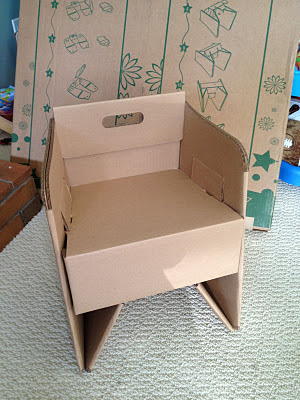
He wasted no time giving it a test run. I was surprised at how unyielding and sturdy the cardboard was. I was tempted to give it a go myself, but decided not to risk it. Mostly because I didn't want to get my rear end stuck in it. The boy, on the other hand, loved having furniture that was just his size.

Soon the second chair was done and it was time to move on to the table. Cue second oh-my-goodness-maybe-I-should-just-leave-it-for-the-husband freak out.

No, no. Smart educated woman and all that. Plus, it wasn't exactly rocket science. The instructions were excellent and the table came together without any trouble. And voilà! There she is. Please ignored the rumpled couch and messy pillows in the background.

The table top was an adorable cat-and-mouse version of Snakes & Ladders. It also came with a hockey arena table top - perfect for these Canadian boys of mine.

The boy promptly challenged his dad and me to a game. You'll be happy to hear I won (woohoo!), and the husband was left shame-faced halfway back on the board (he had a bad run of being eaten by cats).

The mice also decorated the table legs and one chair...

...while this hilariously cute cat graced the other chair.

The boy then challenged his dad to a game of finger hockey. He was too impatient to set the table top up properly; the sides of the arena actually fold up to contain the puck, and there are cardboard nets to be inserted as well. The space below the nets holds the Cats & Tunnels game pieces, crayons, and anything else your child decides to store in there. Mine, unsurprisingly, quickly filled them with cars.

"Hey, I'm awake now! Is it my turn to play?"

A week later, this furniture is still going strong and shows no sign of wear. The chairs are now proudly covered in the boy's drawings, and the tabletop game is much more colourful. The pieces have also been used as forts, shelters, and step stools. They are light enough that the boy can (and frequently does) move them between rooms as needed - out in the living room when the toddler is napping, in the bedroom when the boy has his quiet time, or in the kitchen when he wants to add to his artistic efforts with more marker. The perfect combination of fun and practical!
Interested in buying a set for your own child? Boutique Cascades has generously offered Hippie Housewife readers 25% off any children's furniture when using the code HHWIFE. Discount code expires November 30, 2011.
(This is an unpaid review. I received a complementary table and chairs set in order to provide my honest review of them. I receive no compensation for any sales made as a result of this review.)
This cardboard furniture is made from a minimum of 84% recycled material, and can later be recycled again to continue the cycle. Children love the creative outlet it affords, as they can decorate the furniture with crayons, markers, paint, and stickers.
When the table and chairs arrived at our house, the boy could hardly wait to get them set up. We decided to start with the chairs. I pulled them out of the box and had a flashback to my days as an accountant, setting up banker's boxes for our files. Those attempts often resulted in me chucking a lid across the room and leaving the box for someone else to fold. I was momentarily tempted to just leave the whole thing up to the husband...but no, goshdarnit, I am a grown educated women, I can surely figure this out for myself.

The instructions, printed on the outside of the box, seemed fairly clear. Sure enough, a few minutes later, I had one perfectly-executed chair ready and waiting for the boy.

He wasted no time giving it a test run. I was surprised at how unyielding and sturdy the cardboard was. I was tempted to give it a go myself, but decided not to risk it. Mostly because I didn't want to get my rear end stuck in it. The boy, on the other hand, loved having furniture that was just his size.
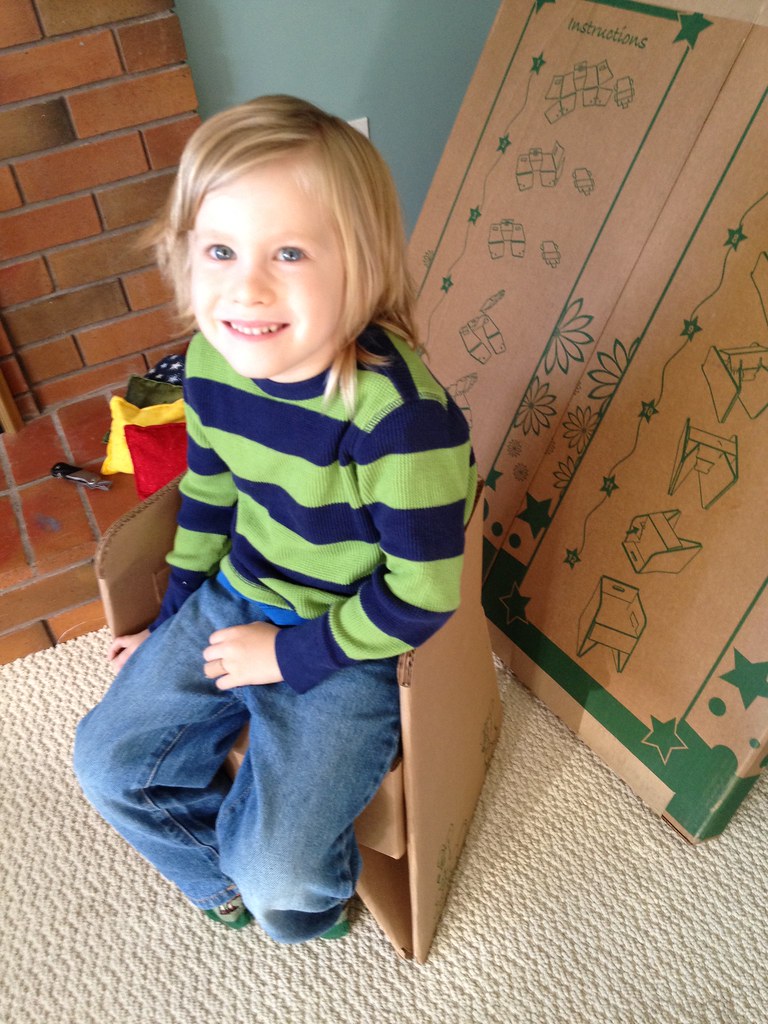
Soon the second chair was done and it was time to move on to the table. Cue second oh-my-goodness-maybe-I-should-just-leave-it-for-the-husband freak out.

No, no. Smart educated woman and all that. Plus, it wasn't exactly rocket science. The instructions were excellent and the table came together without any trouble. And voilà! There she is. Please ignored the rumpled couch and messy pillows in the background.

The table top was an adorable cat-and-mouse version of Snakes & Ladders. It also came with a hockey arena table top - perfect for these Canadian boys of mine.

The boy promptly challenged his dad and me to a game. You'll be happy to hear I won (woohoo!), and the husband was left shame-faced halfway back on the board (he had a bad run of being eaten by cats).

The mice also decorated the table legs and one chair...

...while this hilariously cute cat graced the other chair.

The boy then challenged his dad to a game of finger hockey. He was too impatient to set the table top up properly; the sides of the arena actually fold up to contain the puck, and there are cardboard nets to be inserted as well. The space below the nets holds the Cats & Tunnels game pieces, crayons, and anything else your child decides to store in there. Mine, unsurprisingly, quickly filled them with cars.

"Hey, I'm awake now! Is it my turn to play?"

A week later, this furniture is still going strong and shows no sign of wear. The chairs are now proudly covered in the boy's drawings, and the tabletop game is much more colourful. The pieces have also been used as forts, shelters, and step stools. They are light enough that the boy can (and frequently does) move them between rooms as needed - out in the living room when the toddler is napping, in the bedroom when the boy has his quiet time, or in the kitchen when he wants to add to his artistic efforts with more marker. The perfect combination of fun and practical!
Interested in buying a set for your own child? Boutique Cascades has generously offered Hippie Housewife readers 25% off any children's furniture when using the code HHWIFE. Discount code expires November 30, 2011.
(This is an unpaid review. I received a complementary table and chairs set in order to provide my honest review of them. I receive no compensation for any sales made as a result of this review.)
Wednesday, 26 October 2011
Wordless Wednesday: Strength and clarity

"Deep down, Jack really does want to be good, but he is also strong willed and volatile, often at the mercy of his emotions. What he most needs from me then is not an emotional hurricane of equal fury, but just the opposite - a living example of the kind of strength and clarity that will ultimately show him the way to make constructive use of his own energies. Children need clear boundaries as they learn to master socially acceptable behavior, but they also need exposure to the art of self-control. Where else will my sons learn grace under pressure, if not right here in their own home?"
- Katrina Kenison, "Mitten Strings for God"
Tuesday, 25 October 2011
Bedtime bonding

He repeats his request each night as I go to nurse his little brother off to sleep. "Yes, I'll come," I always reply. "Good night."
I turn my attention to the baby. He's not such a baby anymore, walking and talking and counting and using the potty, but oh, he's still my baby. He nurses for a while, his ever-fidgeting hands flying all over the place. He sticks a finger in my mouth and I nip at it; he stops nursing long enough to grin at me in response.
Eventually he stops, or I stop him, and I sit beside him while he wiggles and fidgets and whispers to sleep. Sometimes I get drawn in, laying nose-to-nose with him and giggling at our silliness. Finally his body stills and his breathing deepens. I brush a kiss across his cheek and inhale his sweet scent before I leave. He is perfection, this sleeping child of mine.
I leave our bedroom and head down the hall to the kids' bedroom, where the older one is waiting for me to "say goodnight and snuggle and talk" with him. Sometimes he's asleep when I get there. I kiss his warm forehead in the dark and whisper a prayer over him before silently leaving.
But when he's awake, I scoot him over and sit down beside him. We talk about our day - the best parts, the worst parts - and about our plans for tomorrow. I don't know what it is about that dark room after bedtime, but somehow it makes the whispers run even more freely than usual. He tells me his thoughts and worries, hopes and confessions. He asks me his biggest questions, often questions so big that I hardly know where to begin in answering them. I wish I had all the answers, darling.
Eventually I bid him a good night, returning shortly with a glass of water in exchange for one last hug and kiss. "I love you, sweetheart."
"I love you too, Mommy."
I melt.
Saturday, 22 October 2011
Weekend Reading
- Little sinners @ Catapult
- Dr. StrangeLiturgy @ Internet Monk
- You say "boundaries" like it's a bad thing @ Milagro Girl
- Why I'm Walking Away From My Children @ Our Small Hours
Wednesday, 19 October 2011

Monday, 17 October 2011
Attachment Parenting: Beyond the baby years
Today in our Attachment Parenting Series, we will be discussing Attachment Parenting beyond the baby years. If you have written a post on Attachment Parenting children, please do share it with us in the comments below!

Introduction
Attachment Parenting during the baby years is fairly straightforward. While the specifics and application varies with each individual family, the seven "Baby B's" provide a basic foundation to caring for a baby with an attachment focus.
Once the toddler years hit, however, many parents are caught off-guard. Parents often find themselves without the practical tools nor the underlying philosophy needed to carry on with AP as their children grow. Suddenly nursing isn't the answer to every difficulty. Crying becomes more difficult to solve. Discipline becomes a challenge. Some parents, unsure of how to navigate their child's big feelings, begin resorting to time outs and other punishments. Others, accustomed to meeting their infant's every need, carry this dynamic into the older years in the form of appeasing their child's every desire. Both of these responses, punitive and permissive, fail to meet the needs of the child or to strengthen the parent/child relationship.
A starting point
A good starting point for parents who have passed the baby stage is Attachment Parenting International's eight Principles of Parenting:
As with Dr. Sears' seven "Baby B's", the specifics and application of each of these principles will vary according to the unique needs of the individual family. Browse through each article to get an idea of how the principles may be applied in your home.
The core of AP
Far more than merely the decision to breastfeed or co-sleep, however, the core of Attachment Parenting is the promotion of a responsive, relationship-based approach to raising children. It encourages the parent to respond sensitively to their child's needs, seeking ways to build and strengthen a mutually-trusting parent/child relationship.
With that in mind, the parent can better determine the specifics in a way that is right for their family. Each AP tool serves to strengthen and build on this relational foundation. Not every family will use every tool or use them in the same way. It is the heart behind the tool – the desire to respond sensitively to the child's needs and to seek ways to build and strengthen a mutually-trusting parent/child relationship – that is of true importance.
Four keys
So how does this play out practically once the baby years have passed? There are four key ideas that will assist parents in staying relationally-focused as their children grow:
1. Focus on solutions: Rather than relying on threats, punishments, bribes, or rewards to control our children's behaviour, keep the focus on seeking solutions. This will allow the parent to discipline the child in a positive, proactive, and connective manner. Provide the child with the opportunity to fix their errors by having them brainstorm solutions and be responsible for making amends. This responsibility should be given to them at increasingly greater levels as they grow.
2. Teach skills: As with focusing on solutions, teaching skills will assist our children in navigating life in a way that keeps their dignity intact. The skills range from the most basic (taking turns, cleaning up messes) to the more complex (problem solving, conflict resolution) We are to actively teach, guide, and disciple them to maturity. Teach them what to do instead of what not to do. Model these life skills as well, and narrate decision-making processes out loud for children to overhear and learn from.
3. Accept emotions: Keep in mind that happy is not the only acceptable emotion. Children will face a number of strong emotions throughout their lives. On the one hand, your job is not to keep your child happy at all costs; on the other, a child should never be shamed or punished for feeling and expressing negative emotions. The goal is to teach them healthy ways to understand, express, and work through those emotions. Parents should not allow the presence or absence of tears to dictate their decisions, but should always come alongside the child to support them through those times using reflection and empathy. Remember that crying is not always something that needs to be fixed.
4. Strengthen relationships: All of our efforts will be futile without a strong parent/child relationship as the supporting foundation. Connect through physical touch, verbal affirmation, and focused quality time.
For more detailed practical tips, refer to The Hows of Discipline and Gentle Discipline for Toddlers.
Avoiding punitive and permissive responses
As mentioned earlier, the two potential downfalls of AP parents who are leaving the baby years include punitive parenting on the one side and permissive parenting on the other.
An AP parent who lacks positive discipline tools may fall back on the popular punitive model in an effort to clamp down on troublesome behaviour. Punitive parenting seeks to modify a child's behaviour through punishment. It is an adversarial style of parenting where the parent comes down on the child from above with the goal of controlling and conquering, rather than coming along side the child to connect and disciple. Parent and child are pitted against each other instead of placed on the same team. A reliance on punishments, however, controls only the outward behaviour and fails to instill strong internal motives. By design, punishment prevents the child from accepting responsibility for their actions, taking ownership of the problem, developing problem-solving skills, and making amends for their mistakes.
In contrast, permissive parenting neglects to provide children with the safety of consistently enforced boundaries. Permissive parenting may rely heavily on praise to achieve the desired results, but the absence of punishment fails to make this a positive parenting technique. This is the more common downfall for the AP parent who, having acknowledged that a baby's needs and wants are very much the same thing and being accustomed to meeting their baby's needs in a sensitive and responsive manner, carries the same attitude over into the toddler and older years. Even though the child's wants and needs are no longer one and the same, the parent continues to act as though they are.
Children thrive best within a framework of healthy boundaries. Without these limits, the child will act out in search of them, seeking their safety and predictability. It is this desire for predictable boundaries that makes punishment-based parenting programs appear to work. The parent is instructed to consistently punish the child when they overstep a boundary, and it is this consistency, rather than the punishment itself, that has positive results. Unfortunately, the physical and emotional pain that accompanies punishments has many negative results, and the child will internalize this bad along with the good.
Much of what is considered punitive parenting is actually permissive parenting. Rather than calmly and consistently enforcing age-appropriate boundaries, this style of permissive parent allows the child to overstep boundaries over and over again until the parent explodes with frustration and overreacts, coming down strong to get the child's behaviour back in line. This may happen with no warning, leaving the child walking on eggshells for fear of triggering the unexpected annoyance, or it may happen after several unenforced warnings. This latter sort of inconsistency is equally confusing the child, who never knows when the parent "really means it" and when it's just one in another long stream of baseless warnings, culminating in the final punitive enforcement when the parent decides they've had enough.
Attachment Parenting is incompatible with both of these parenting styles. It eschews the punitive response, with its focus on external behaviour above the internal, as well as the permissive response, with its lack of consistently-enforced age-appropriate boundaries. Attachment Parenting focuses instead on building the parent/child relationship and, from the mutual trust and respect that arises from that relationship, coming along side the child to teach and guide them to maturity.
Summary
Attachment Parenting can be fairly straightforward during the baby years, but many parents are caught off-guard by the more difficult demands of parenting children. While the eight "Principles of Parenting" offered by Attachment Parenting International can provide a starting point, which parents can then implement in a way that meets the unique needs of their family, it is helpful to first have an understanding of the underlying core of AP.
The heart of AP is the promotion of a responsive, relationship-based approach to raising children. It encourages parents to respond sensitively to their child's needs, seeking ways to build and strengthen a mutually-trusting parent/child relationship.
To maintain this responsive and relational focus, there are four keys that can provide positive direction. First, focus on seeking solutions rather than imposing consequences. Second, teach the child useful life skills, such as problem-solving and conflict resolution, rather than focusing on instructing the child on what not to do. Third, assist the child in understanding, expressing, and working through their emotions in healthy ways, rather than allowing either parent or child to be controlled by the child's emotions. Finally, always seek to strengthen the parent/child relationship through the use of physical touch, verbal affirmation, and focused quality time.
This parent/child relationship is not adversarial, with the parent coming down from above to control or conquer, but rather places the parent and child on the same team, with the parent coming along side to connect and disciple. Conversely, the parent/child relationship is not indulgent, with the parent seeking to appease the child's every desire, but instead aims to provide the child with the security of consistently-enforced boundaries while providing them with the skills and support needed to grow into maturity.
By avoiding the dangers of both punitive and permissive parenting, the AP parent is free to focus instead on building the parent/child relationship and, from the mutual trust and respect that arises from that relationship, coming along side the child to teach and guide them to maturity.
Recommended Reading:
Raising An Emotionally Intelligent Child by John Gottman, Ph.D.
How to Talk So Kids Will Listen & Listen So Kids Will Talk by Faber and Mazlish
Kids Are Worth It!: Giving your child the gift of inner discipline by Barbara Coloroso
The Discipline Book and The Successful Child by William Sears, M.D. and Martha Sears, R.N.

Introduction
Attachment Parenting during the baby years is fairly straightforward. While the specifics and application varies with each individual family, the seven "Baby B's" provide a basic foundation to caring for a baby with an attachment focus.
Once the toddler years hit, however, many parents are caught off-guard. Parents often find themselves without the practical tools nor the underlying philosophy needed to carry on with AP as their children grow. Suddenly nursing isn't the answer to every difficulty. Crying becomes more difficult to solve. Discipline becomes a challenge. Some parents, unsure of how to navigate their child's big feelings, begin resorting to time outs and other punishments. Others, accustomed to meeting their infant's every need, carry this dynamic into the older years in the form of appeasing their child's every desire. Both of these responses, punitive and permissive, fail to meet the needs of the child or to strengthen the parent/child relationship.
A starting point
A good starting point for parents who have passed the baby stage is Attachment Parenting International's eight Principles of Parenting:
- Prepare for pregnancy, birth, and parenting
- Feed with love and respect
- Respond with sensitivity
- Use nurturing touch
- Ensure safe sleep, physically and emotionally
- Provide consistent and loving care
- Practice positive discipline
- Strive for balance in personal and family life
As with Dr. Sears' seven "Baby B's", the specifics and application of each of these principles will vary according to the unique needs of the individual family. Browse through each article to get an idea of how the principles may be applied in your home.
The core of AP
Far more than merely the decision to breastfeed or co-sleep, however, the core of Attachment Parenting is the promotion of a responsive, relationship-based approach to raising children. It encourages the parent to respond sensitively to their child's needs, seeking ways to build and strengthen a mutually-trusting parent/child relationship.
With that in mind, the parent can better determine the specifics in a way that is right for their family. Each AP tool serves to strengthen and build on this relational foundation. Not every family will use every tool or use them in the same way. It is the heart behind the tool – the desire to respond sensitively to the child's needs and to seek ways to build and strengthen a mutually-trusting parent/child relationship – that is of true importance.
Four keys
So how does this play out practically once the baby years have passed? There are four key ideas that will assist parents in staying relationally-focused as their children grow:
1. Focus on solutions: Rather than relying on threats, punishments, bribes, or rewards to control our children's behaviour, keep the focus on seeking solutions. This will allow the parent to discipline the child in a positive, proactive, and connective manner. Provide the child with the opportunity to fix their errors by having them brainstorm solutions and be responsible for making amends. This responsibility should be given to them at increasingly greater levels as they grow.
2. Teach skills: As with focusing on solutions, teaching skills will assist our children in navigating life in a way that keeps their dignity intact. The skills range from the most basic (taking turns, cleaning up messes) to the more complex (problem solving, conflict resolution) We are to actively teach, guide, and disciple them to maturity. Teach them what to do instead of what not to do. Model these life skills as well, and narrate decision-making processes out loud for children to overhear and learn from.
3. Accept emotions: Keep in mind that happy is not the only acceptable emotion. Children will face a number of strong emotions throughout their lives. On the one hand, your job is not to keep your child happy at all costs; on the other, a child should never be shamed or punished for feeling and expressing negative emotions. The goal is to teach them healthy ways to understand, express, and work through those emotions. Parents should not allow the presence or absence of tears to dictate their decisions, but should always come alongside the child to support them through those times using reflection and empathy. Remember that crying is not always something that needs to be fixed.
4. Strengthen relationships: All of our efforts will be futile without a strong parent/child relationship as the supporting foundation. Connect through physical touch, verbal affirmation, and focused quality time.
For more detailed practical tips, refer to The Hows of Discipline and Gentle Discipline for Toddlers.
Avoiding punitive and permissive responses
As mentioned earlier, the two potential downfalls of AP parents who are leaving the baby years include punitive parenting on the one side and permissive parenting on the other.
An AP parent who lacks positive discipline tools may fall back on the popular punitive model in an effort to clamp down on troublesome behaviour. Punitive parenting seeks to modify a child's behaviour through punishment. It is an adversarial style of parenting where the parent comes down on the child from above with the goal of controlling and conquering, rather than coming along side the child to connect and disciple. Parent and child are pitted against each other instead of placed on the same team. A reliance on punishments, however, controls only the outward behaviour and fails to instill strong internal motives. By design, punishment prevents the child from accepting responsibility for their actions, taking ownership of the problem, developing problem-solving skills, and making amends for their mistakes.
In contrast, permissive parenting neglects to provide children with the safety of consistently enforced boundaries. Permissive parenting may rely heavily on praise to achieve the desired results, but the absence of punishment fails to make this a positive parenting technique. This is the more common downfall for the AP parent who, having acknowledged that a baby's needs and wants are very much the same thing and being accustomed to meeting their baby's needs in a sensitive and responsive manner, carries the same attitude over into the toddler and older years. Even though the child's wants and needs are no longer one and the same, the parent continues to act as though they are.
Children thrive best within a framework of healthy boundaries. Without these limits, the child will act out in search of them, seeking their safety and predictability. It is this desire for predictable boundaries that makes punishment-based parenting programs appear to work. The parent is instructed to consistently punish the child when they overstep a boundary, and it is this consistency, rather than the punishment itself, that has positive results. Unfortunately, the physical and emotional pain that accompanies punishments has many negative results, and the child will internalize this bad along with the good.
Much of what is considered punitive parenting is actually permissive parenting. Rather than calmly and consistently enforcing age-appropriate boundaries, this style of permissive parent allows the child to overstep boundaries over and over again until the parent explodes with frustration and overreacts, coming down strong to get the child's behaviour back in line. This may happen with no warning, leaving the child walking on eggshells for fear of triggering the unexpected annoyance, or it may happen after several unenforced warnings. This latter sort of inconsistency is equally confusing the child, who never knows when the parent "really means it" and when it's just one in another long stream of baseless warnings, culminating in the final punitive enforcement when the parent decides they've had enough.
Attachment Parenting is incompatible with both of these parenting styles. It eschews the punitive response, with its focus on external behaviour above the internal, as well as the permissive response, with its lack of consistently-enforced age-appropriate boundaries. Attachment Parenting focuses instead on building the parent/child relationship and, from the mutual trust and respect that arises from that relationship, coming along side the child to teach and guide them to maturity.
Summary
Attachment Parenting can be fairly straightforward during the baby years, but many parents are caught off-guard by the more difficult demands of parenting children. While the eight "Principles of Parenting" offered by Attachment Parenting International can provide a starting point, which parents can then implement in a way that meets the unique needs of their family, it is helpful to first have an understanding of the underlying core of AP.
The heart of AP is the promotion of a responsive, relationship-based approach to raising children. It encourages parents to respond sensitively to their child's needs, seeking ways to build and strengthen a mutually-trusting parent/child relationship.
To maintain this responsive and relational focus, there are four keys that can provide positive direction. First, focus on seeking solutions rather than imposing consequences. Second, teach the child useful life skills, such as problem-solving and conflict resolution, rather than focusing on instructing the child on what not to do. Third, assist the child in understanding, expressing, and working through their emotions in healthy ways, rather than allowing either parent or child to be controlled by the child's emotions. Finally, always seek to strengthen the parent/child relationship through the use of physical touch, verbal affirmation, and focused quality time.
This parent/child relationship is not adversarial, with the parent coming down from above to control or conquer, but rather places the parent and child on the same team, with the parent coming along side to connect and disciple. Conversely, the parent/child relationship is not indulgent, with the parent seeking to appease the child's every desire, but instead aims to provide the child with the security of consistently-enforced boundaries while providing them with the skills and support needed to grow into maturity.
By avoiding the dangers of both punitive and permissive parenting, the AP parent is free to focus instead on building the parent/child relationship and, from the mutual trust and respect that arises from that relationship, coming along side the child to teach and guide them to maturity.
Recommended Reading:
Raising An Emotionally Intelligent Child by John Gottman, Ph.D.
How to Talk So Kids Will Listen & Listen So Kids Will Talk by Faber and Mazlish
Kids Are Worth It!: Giving your child the gift of inner discipline by Barbara Coloroso
The Discipline Book and The Successful Child by William Sears, M.D. and Martha Sears, R.N.
Subscribe to:
Posts (Atom)