Showing posts with label family. Show all posts

Wednesday, 23 November 2016

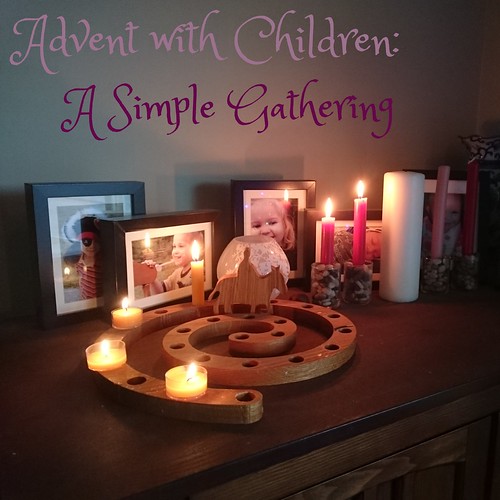
Advent with Children: A Simple Gathering


Advent begins this Sunday. Often I would still be scrambling to make the necessary preparations at this point, but several years of trial-and-error have smoothed the process for our family.

Some years we stay home throughout Advent, while other years have us finishing off the Advent season while travelling to visit family for Christmas. This is a travel year, with the particular joy of getting to spend time with two new nephews born in the past few months.

Whether we travel or stay home, we have always worked to observe Advent in some sort of meaningful way with our children. While always shaped by the particular needs of the family, we have found a steady rhythm in a simple daily gathering.

A Simple Daily Gathering:

1. Candles

We begin by lighting a candle together, which lends a sense of wonder and solemnity to this time of gathering.
    • A traditional Advent wreath is first lit on the first Sunday of Advent, with an additional candle lit each week.
    • A spiral wreath such as this cradle-to-cross wreath or wooden spiral candle holder will count down the days from December 1 until Christmas.
    • Any stand-alone candle can be used instead of a more traditional wreath; more important than the colour or the number of candles is the ritual of marking the beginning of this time of gathering in a distinct way.

2. Scripture

Next we settle ourselves on the couch and read a portion of Scripture. This can be combined with the Jesse Tree portion (below) or can be an additional reading of some sort.

3. Jesse Tree

A Jesse Tree, comprised of 25 stories and their corresponding symbols, tells the story of Christ from Creation to the Messiah's birth. Traditionally a small tree is used on which a new ornament is added after each reading; however, the physical tree, while a nice concrete addition, is not integral to the progression of the story.
    • Unwrapping the Greatest Gift by Ann Voskamp is a popular option, with free colouring pages and tree ornaments to go along with each story.
    • The Jesse Tree by Geraldine McCaughrean is a stand-alone story, which is particularly useful during years of travel. Corresponding ornaments can be created in a variety of ways, however, for those who appreciate the inclusion of a tree.
    • There are countless homemade options and other published Jesse Tree resources that allow you to tailor this time to your family's particular ages and preferences; browse Google or Pinterest until you find your favourite!

4. Hymn

Each week we choose a new Advent hymn to sing together at this point in our gathering. This year our selections include:
    • Come, Thou Long Expected Jesus
    • O Come, O Come Emmanuel
    • Love Divine, All Loves Excelling
    • Lo! He Comes With Clouds Descending

5. Prayer and Peace

We close with a short Advent prayer before exchange the Peace and blowing out the candle.
    • The Anglican Family Prayer Book by Anne Kitch is an excellent resource based on the Book of Common Prayer. I appreciate how much it simplifies the process of responsive prayer for our family.
    • Your own preferred Advent resource is likely to include a prayer for the day.
    • A simple free-form prayer can be offered in response to the days' readings. When going the free-form route, I often have each child share something for which they are thankful as a simple low-pressure addition to our collective prayer.

The details of our time of gathering changes with each year, but this outline provides a simple framework on which to hang those particular details. The basic pattern of coming together with a sort of ritual, moving into the reading of Scripture and/or devotional, and closing with a hymn and prayer provides unlimited potential for shifting and shaping this time in a way that feels smooth and right for your family.

While reviewing my Advent reflections in my Sacred Ordinary Days planner, I noticed that I had made note to not neglect my own personal Advent reflection and prayer. In that vein, my favourite grown-up Advent resources include:

I hope you find some encouragement above as you create Advent rhythms and traditions with your children. December is a busy month, and a simple time of gathering can prevent us from moving too quickly into Christmastide while also allowing us to prepare our hearts in anticipation of Christ.

How does your family observe the Advent season? Please share your favourite traditions or resources as inspiration for the rest of us! 

Tuesday, 5 April 2016

The Rhythms of Our Days

We settled into a good rhythm over the winter, easy and natural, a comforting flow to our rainy days. I have not always been particularly good at this. It was not until my first child left behind his go-with-the-flow infancy that I was forced to begin to shape our days into a steady routine. I sought a predictable beginning, middle, and end, with room to wander as life lead us.

And yet it remained a challenge for my distractable and disorganized self. I wanted to mark the rhythm of our days, weeks, seasons, and years. I wanted the comfort and security of routines for my children. I wanted to continue our journey towards intentional living, ensuring that the things we valued were not forgotten as our time idly slipped away from us. I just wasn't very good at it.

It's been six years since I first recognized the value of rhythm in our days. I have managed to find that rhythm in certain seasons, steady and reliable, while during other seasons it has slipped away from me. It has been a trial-and-error endeavor, up and down, off and on, but overall there has been a positive progression. Now, at last, our rhythms shape and guide our daily lives, rooted with anchor points, carried along by intentional habits, and ever being fine-tuned to fit our needs.

Right now that rhythm begins before dawn. I get up early with the husband to fit in my run or yoga. I settle into my morning quiet time while he heads off to work and the kids continue to sleep. My early mornings have become more life-giving than I ever would have imagined, and I most definitely notice its absence on days when it doesn't happen.

During this quiet morning time, I read Scripture, pray, journal, and read from my current non-fiction book. This is the sort of reading that I find more challenging during the day, when I won't have the devoted time needed to focus on the words, or at the end of the day, when I'm too tired to give it the thought required. After reading, I review our upcoming day, and then I do a bit of work or writing if I have extra time. And drink coffee. Of course.

The kids wake up one at a time. Ell is nearly always the first, with baby Min close behind. Jay and Kai sleepily wander out eventually, unless we have time-sensitive plans and I have to wake them up (to a chorus of grunts and grumbles and roars, the little bear cubs). After reading a couple of story books while they wake up properly, it's time for breakfast, followed by a bit of play time. Mid-morning we settle in to our sit-down time together, which may include any or all of devotional time, reading, writing, math, and science or geography. By then it's lunch time, during which we have our history read-aloud.

After lunch is our daily quiet time. Min naps while the other three occupy themselves with solitary activities (reading, puzzles, games, and so on) or head outside for some backyard playtime. I work until Min wakes up. There's often time for a game or two before moving on to dinner preparations. Post-dinner is the usual busy evening activities of clean-up time, baths, teeth brushing, bedtime story, and so on. Before I go to sleep myself, I set out the various things I need for morning - coffee supplies ready, stack of books waiting, clothes chosen. That morning time is precious to me and I wish to waste as little of it as possible.

I have been focusing this year on cultivating a deeper sense of home, and rhythm, I've discovered, is an integral part of that. Rhythm provides the hooks on which to hang our activities, our priorities, and our values. I can wake up in the morning knowing that all of the thought is taken out of our plans - the myriad of daily decisions, the preparations, the choosing of what and when and how, the fitting in of what matters to us as time carries us along. I can just get on with what needs to be done, more fully present in the moment and with less worries for the next few steps ahead.

But our rhythms are continually being adjusted, and this spring season has called for new life to be breathed into these old winter routines. We have been setting down the pencils and spending all the lovely mornings outside, at the playground, the beach, or walking through our favourite wooded areas. Our afternoons are still similar, allowing the baby to get in his nap (I will call him a baby forever and ever and don't you try to make me start calling him a toddler already, I don't care if he's walking everywhere and getting into everything and throwing epic toddler tantrums to go along with his Very Big toddler opinions) and providing me with a consistent time in which to do my work.

I find these times of rhythm transitions to be challenging. I feel off-kilter for a while, feeling my way semi-blindly through our days. I miss the simplicity of knowing generally how the day will unfold, and decision fatigue wears on me quickly. Eventually, though, we settle into the new season, rhythm lighting the path ahead, an ever-evolving framework for our family to grow up in.

Sunday, 9 August 2015

In Praise of Quiet Time

I love my children. Being a mother is hard. Our days are precious to me. Our days are challenging. Both parts are true, the beauty and the intensity, but the one practice that helps to keep things in balance for me is our daily afternoon quiet time.

Our quiet time is a mini exhale, an oasis of calm in the midst of our usual noise and activity. It is blessed relief to my introverted soul. It is silence and stillness, just for a little while. It is rest for my mind and body and oh, my ears.

Right now there is only quiet. I can hear the hum of the refrigerator and the tapping of the keys as I write. Sometimes a car drives by. For the next hour or so, I will hear little else.

Our practice of quiet time began six years ago. Jay, who was two years old back then, had decided he was done with naps. Kai was an energy-sucking bundle of joy within me. I was tired. Jay might have been fine without his afternoon nap, but I sure needed one. And so it began.

A stack of books. Two cars. One blanket. We'd pile into my bed and for the next half hour, I was not to be spoken to. I would read (sometimes) or nap (usually), while Jay would drive his cars along the lines of my quilt or look through his stack of books. Occasionally he would fall asleep too, and the two of us would nap for as long as we pleased. It was a nice moment in our day. When it was over, I would drag my big Kai-filled belly out of bed and the day would continue. Back to housework and games, meal prep and strolls through the forest.

After Kai was born, quiet time became an on-again, off-again thing for the next couple of years. The off-again times always left me feeling a little more frazzled, a little less calm and collected. But I wasn't very good at consistency and routine, and so the off-again times happened anyway.

Until Ell. Oh, that pregnancy. Quiet time became less of a decision and more of a default-born-of-necessity; I wasn't so much functioning as merely getting through the day for a stretch there. We made it, though, and at some point that afternoon quiet time became part of our day, a simple fact. This is What We Do. And so we do it.

For the kids, quiet time is an opportunity for rest and quiet activity. It is also a chance for solitude, to enjoy (or learn to enjoy) their own company for a while. Jay will read, work on a project, or draw. Kai usually chooses a puzzle or a game. Ell is in that transitioning period; some days she naps, while other days she chooses a quiet activity of her own. And Min, bless his baby soul, consistently naps during this time.

For me, though, its purpose changes depending on the season. There have been seasons (particularly the growing-a-baby seasons) when it has been an opportunity for a nap of my own. Other seasons have given way to creativity, a chance to write or sew or knit. Sometimes I read. Sometimes I sit quietly with God, a tiny baby, or both. It is never a time for a housework, though. I might do a quick tidy of the main room simply because visual clutter feels like chaos to my brain, and five minutes of tidying makes my quiet time feel far more peaceful.

Right now, in this season, it is my work time. I plug in my headphones, turn on some music, and get lost in the world of numbers and accounting for as long as the baby sleeps. It might not be rest in the traditional sense, but it requires, at least, a different part of my brain that the usual negotiating of peace treaties between warring children, the cleaning up of various bodily fluids, and the other assorted duties that go along with raising children.

Whether it be for sleep, creativity, recreation, or work, these minutes have become an integral part of my day. They are given up only for the occasional full-day outing. What begun as a half-hour nap beside a squirmy two year old has become a guaranteed one hour, and often more, of solitary activity for each of us. As important as I believe it is for my kids, it is one of my own primary acts of self-care. I do the next needful thing and the next and the next and then this - a pause, a stillness - and then continue.

Thursday, 11 June 2015

Inspiring Dinnertime Conversation

"No books at the dinner table" is easily Jay's least favourite rule in our home. Being lovers of books ourselves, the husband and I sympathize with his plight, but that's the rules, sorry Love. Dinner time is for talking, not reading.

Every evening we gather at the table, marked as it is with scratches and burns and glitter and paint. We hold hands as we offer our thanks. Water is poured, food is passed around, pieces are cut for those who need it. There's noise and a few moments of chaos and then everyone settles in to their dinner (save for the occasional "I'm not eating THIS" holdout).

And then our dinner conversation begins.

"What did you learn today?"

It's a simple question, but the discussions it has created since its introduction a few months ago have been nothing short of fascinating. Jay likes to share a random "weird but true" piece of trivia with us. Kai usually insists he didn't learn a thing, but a bit of prompting often coaxes a tidbit out of him - a new word he sounded out on his own, a fact picked up in an earlier conversation, a new game he learned, a unique Lego creation from the day's play. Ell "didn't yearn nuffink today," but she's happy to chatter away just the same.

Then it's our turn. The husband has often read about a new scientific discovery to share with us, and I round things up with something from my own day's reading - a new-to-me nature factoid, a social justice campaign, a young entrepreneur, a bit of world news, a new skill I've been working on, whatever inspires me when the question comes 'round my way.

Sometimes we each share our little bit of learning and the conversation moves on. Usually, though, we find ourselves exploring one of the introduced topics at a deeper level, or branching off into related discussions - from science to math to etymology to social awareness, wherever the kids' questions (and our own) lead us. What started as a deliberate way to stimulate conversation, share information, and keep all interested parties appraised of the kids' homeschooling situation (not to mention take some of the sting out of Jay's book prohibition at the dinner table), has become one of our prime opportunities to learn and ask and rabbit trail to our hearts' content.

Last night's conversation began with the automated cameras recording Serengeti life. But what is an aardwolf? or a zorilla? How big are they? How big are they when they're born? What does "aard" mean? What does "aardvark" mean? How many ants does it eat in a day? How many seconds are there in a week? So how many ants is that per second? And so it goes.

The question itself was chosen not for its informative opportunities, though, but rather for its encouragement to always keep learning. Listen, Daddy learned something new today. So did Mommy. And you? What did you learn? What do you have to contribute to our conversation? We all have something to share. Learning isn't limited, isn't top-down, isn't separate from our daily lives. It isn't dull and boring and forced, something to suffer through until free time can begin again. It has no beginning and no end. It is part of what makes us human.

It has been good, this question, a lovely addition to our frequent bedtime conversations, which hold familiar questions of their own. Keep the conversation going, keep quietly pointing them to all that is good and worthy, keep listening and learning and hearing as they tell you, piece by piece, who they are.

Do you have a regular topic or question that you use to inspire dinnertime conversation?

Tuesday, 3 July 2012

Letting go of the checklist

It started with joy.

Only it wasn't.


It was JOY in capitals, JOY the acronym, JOY which meant Jesus --> Others --> You.

Jesus first, always Jesus, and then look to the needs of others. When those needs are met, if there's anything left in you, then go ahead and indulge in caring for your own needs. Quickly though; soon enough, it will be time to start at the top again. Jesus. Others. You.

Then I got older, joined the ranks of married women, of mothers. JOY wasn't enough anymore; now it was a very specific order:
  1. God
  2. Husband
  3. Children
  4. Others
  5. You
It didn't have a cheerful little acronym to go along with it, but who needed one? I came across it everywhere. Always it would begin with a brief nod to God being our ultimate priority. This was followed by a stern reminder that we as wives were under our husband's authority, and we were to serve him and meet his needs above all others. Keep him happy to keep him holy.

With that in mind, our children were given the next prioritization. After all, motherhood was a woman's greatest calling (whatever that meant for the unwed or childless among us, and however that fit with being ranked #3 on our list of priorities). We were raising up the next generation of great Christian leaders; it was imperative that we tend to them after our husbands. Always, though, impress upon them the fact that we esteemed our husbands above them. They must know which relationship we prioritized.

Once the needs of home and family were cared for, it was time to turn outwards. Meet the needs of others. Volunteer, serve, get involved. Tend to the children's ministry. Bake cookies. Visit the sick and the elderly. Sign up for this, that, and the other. Sometimes this step was broken down more specifically (such as "extended family, church, work, others"), but the idea was the same. Others others others.

At last would come the obligatory closing: you have needs too, so find time to meet them. Just be sure it's done after your obligations to God, your husband, your children, and everyone else.

That, I read over and over, was to be the order of my life. A nice tidy checklist, simple to follow and indisputable in its order of importance. Check, check, check, top to bottom. God husband children others you.

If only life were so linear.

I tried, for a time, to fit into this Good Christian mold. A bit of prayer time or Scripture reading and check, first thing off my list. Next I'd ask my husband if there was anything he needed. Being an extraordinarily unneedy person, he'd usually just give me a curious look, a shrug, and an easy pass to go on with my day. Another check, although I'd spend my day hyper-focused on his needs, determined to meet them whenever they may finally arrive. I'd worry if dinner wasn't perfect or if I fell behind in laundry or if heaven forbid the child was being too much of an "inconvenience" to him.

The rest of the day was spent tending to our firstborn (check). When he was asleep, I'd take care of whatever external obligations had built up over the day (check). Finally, it was time to meet my needs...usually by falling into bed exhausted. What other needs could I afford besides food and sleep?

I am immeasurably grateful that this pattern was short lived. Soon, through an unexpected string of events, I began my journey towards a more intentional way of life. It wasn't enough anymore to simply unquestioningly do what was expected of me. I wanted to know why. I wanted to know if it truly had any firm foundation. I began to dig deeper and in doing so I came to a more holistic, authentic, and life-giving understanding of God than I'd ever had before.

Lacking in both logic and biblical backing, the ladder of priorities was one of the first constructs to go. Life was not so simplistic and compartmentalized; life was messy and interconnected and beautifully so. Life was not a checklist, a hierarchy, a ladder, or a straight line. It was circular, it ebbed and flowed, it changed with the seasons and the needs and the joys and the challenges. It demanded balance and give-and-take, not ranks and tidy checks on a list.

Although I didn't have words for it at the time, I soon found myself embracing a more circular view of my priorities. Instead of simply being the first item to check off in my day, God became the center and source of everything, with the things close to my heart radiating outwards like the spokes of a wheel. God was part of all areas of my life; it was all worship when done as worship.

With the checklist gone, I began to learn how to weave my priorities into the everyday fabric of my life. Everything connected, overlapped, and somehow worked together. My time with God was no longer required to be independent of my time with my children. We lived those relationships together and God was everywhere, in all of it, in our songs and our discussions and our praises and our activities. My husband, too, became part of it all; even when he was away, I sought to honour him and consider his needs and desires, not out of obligation as a subordinate but out of love as his ezer kenegdo, his valiant ally. Others, too, became part of our everyday lives, all of us living life together.

We don't always get it right, but the freedom found in letting go of the rankings has allowed us an authenticity we didn't have when I was trying to separate life into ordered compartments. Sometimes needs arise in one area and demand precedence over other areas. We embrace that and work with it rather than trying to force it into its proper rung on the ladder, ignoring it until the higher rungs are taken care of. As long as we allow God to be at the center and everything else to radiate out from Him, things seem to fall into place.

Everything is from Him and through Him and for Him; He alone makes everything good.

Tuesday, 26 June 2012

The Gift of a Sibling


I watch them playing together, these two boys of mine. They build a city across the living room, each adding pieces here and there, a twisting mass of rails and roads and animals and vehicles. They talk and laugh, oblivious to the rest of the world.

I watch them come to a disagreement. I don't step in, not yet. I wait, and there it is, the boy's calm defusing: "We're starting to fight again. Can we find something else to do together?" Little brother agrees and their play resumes in peace. It doesn't always work out that way, but when it does, it is so very good.

I watch them later. The boy wants some quiet time in his room, so I gently steer a heartbroken little brother away. I know how the boy feels; I often crave that alone time myself. But, tenderhearted boy that he is, he hears his little brother's cries and opens the door, invites him in. They snuggle together on a bed and page through books. It's only quiet for a short time before the giggling and play begins again.

*******

Once upon a time, two pink lines told me my long-desired second child was beginning to form within my womb. I celebrated joyously.

I also doubted.


What was I doing to my firstborn by bringing another child into our home? Would he resent his big-brother role? Suddenly I was tired and sick; how unfair to him that we no longer spent our days as we once did! I was, for the first time, snapping impatiently at my beautiful little boy; would I ever be the same patient mother I once had been?

Little brother arrived and the boy was enthralled. He held his brother, snuggled with him, touched his fingers and peeked under his hat to see his ears. He was soon making his brother smile, then laugh. He cheered his brother on through each new stage.

And still I doubted.

I was too tired, too impatient, too worn out. I spent too long putting the baby to bed while the boy waited patiently on the other side of the door. Our old habits had been replaced with a new life; no longer did we bake together every week or take a walk every day. I no longer tackled the big projects with the energy I once had; instead I accepted them reluctantly, half-heartedly, or pushed them off altogether. There was so much guilt and I worried. Had he lost out when we took away his only-child status?

*******

Two more pink lines later and once again my energy was sapped, my patience lowered. Again long-awaited, again much-celebrated, and again the doubt and guilt.

Only now the doubt and guilt were doubled. Just look at them, playing together, loving each other, hugging and wrestling and laughing and best friends, these two are.

What have I done?

What will a third child mean? How will it change their relationships? How will this little one fit in; is someone always going to be the third wheel, left out, feelings hurt, tears falling?

Will my big boy, so responsible, so willing to do for others, grow to feel that we asked too much of him? More responsibility, less responsibility, I never know what's right. He's so small, this oldest of my babies. So big and so small.

His little brother will become a middle child. I don't know what that means; I was the oldest and only know the good and bad of that role in a family. I don't want my affectionate little boy to feel forgotten, overlooked, invisible is his position as neither oldest nor youngest.

And what will it mean for me? More children than hands, myself spread yet more thin. I don't want to be the impatient mother, the too-tired mother, the no-not-today-maybe-tomorrow mother, lacking both time and energy. I am afraid.

*******

I watch them. I watch and fears begin to fade, because such brotherly love and joy can only be a gift. One more can only be an addition, not a subtraction. Maybe their lives would be different if they were onlies - maybe we'd do more, explore more, travel more, tackle more, I don't know - but this gift of each other is something I could never wish away.

Their excitement over the new baby is infectious. The older one can hardly wait. The younger one pokes and prods my growing belly, asking question after question - is the baby sleeping? eating? pooing? ready to come out now? - and finishing with a hug and kiss before pulling my shirt back down. These two, they have no doubts, no fears. They simply embrace and I have so much to learn from them.

*******

It is late and I open their door, wait for my eyes to adjust to the dark. There they are. Even in sleep, they are touching, always touching, and I know: this is a gift. Always, always, a new sibling is a gift. This new little brother or sister will only add to their joy.

They are all three so very blessed.

Monday, 4 June 2012

Preparing siblings for a new baby

With less than three months to go, preparations are beginning in earnest for Mystery Baby. Then again, our preparations are rather basic; there's not a lot we need for a third baby and much of the work will be done closer to his or her expected arrival. Preparing the two boys, however, has been a process that begun the day we told them we were expecting and will continue in a different manner even after the baby has arrived.

Because each of our children were a month shy of two years old when I became pregnant with their younger sibling, we've been able to have conversations at a more detailed level than we otherwise may have. While some of the specifics have been a bit fuzzy or mixed up in their young minds, the basic concept has been relatively easy for them to grasp. These are some of the ways we introduce the children to the idea of a younger sibling; as always, I look forward to your additional suggestions in the comments.

Who do you love?

Talking about the people we love is one of our primary ways of introducing siblings to the idea of Mommy and Daddy loving the new baby as well as them. These lists take various forms, including "I love...", "who do you love?", and "who loves you?".
"Mommy loves you. I love your brother. I love Daddy. I love the new baby growing in my tummy. I love Grandma and Grandpa. I love Oma and Opa. I love..."
These conversations are casual, spontaneous, filled with laughter (and often tickles), and take place even when we're not expecting a new baby. They are one of our bedtime calming games and a fun way to bond while remembering loved ones both near and far. We've found the "new baby" is soon added to their own lists after hearing our lists grow to include him or her.

What will you do?

Two more casual conversations we use to introduce siblings to the idea of "life after the new baby" center on brainstorming things they can do with the baby and things they can do while the baby nurses/sleeps/etc.

"What will you do with the baby?" focuses on ways they can help care for the baby (assisting with diaper changes, for example), entertain the baby (such as singing songs or reading books to him or her), and gently show the baby love (soft touches, kisses, and so on).

"What will you do while the baby _____?" focuses more on them instead of on the baby. What can they do while the baby is nursing? They can, for example, snuggle beside me while I read to them. What can they do while the baby is sleeping? We can play board games or do puzzles together. What can they do when the baby is crying? Maybe sing quiet songs, make silly faces, or help Mommy get ready to feed the baby.

We talk about these things as they naturally arise in our day-to-day conversations, and the kids enjoy brainstorming with us. When they're done talking about it, no problem; we simply move on with our day.

Making it concrete

Interact with the baby

Both of the boys love feeling the baby move around inside of me. It gives them a chance to interact with the baby. Other interactive things they enjoy include putting their ear on my belly to "hear" the baby, assisting the midwife during our prenatal appointments, seeing the baby during ultrasounds, and speculating about what the baby is doing in there right now.

Look at the baby

While they can't see our own baby (aside from ultrasounds), looking at photos of babies in utero helps them to better understand how things work. For example, our toddler had become convinced that the baby was already drinking Mommy's milk; sitting down to look at a baby in the womb allowed me to point out the placenta, the umbilical cord, and give him a basic two-year-old-level introduction to the way baby receives nutrition while inside of me. Similarly, when the boy wanted to know how the baby got out, being able to point to the birth canal and show how the baby would move from the womb out into the world made things clearer than my initial verbal explanation had.

Our absolute favourite resource is the University of Maryland Medical Center's interactive fetal development slide. Both of the kids love seeing the baby grow bigger and smaller, bigger and smaller, over and over and over again. Personally, I just cringe at the visual of my organs being squished up towards my lungs; suddenly the heartburn and shortness of breath make complete sense.

Touch the baby

In addition to looking at photos of babies in utero, having opportunities where they can interact with real live babies has been excellent preparation. We are blessed to have many friends with little babies right now, so the toddler especially has had a great pre-introduction to the concepts of touching gently and not jabbing the baby in the eye.

Hold the baby

Finally, providing them with their own baby dolls gives them the chance to nurture their "baby" and experiment with the concepts of giving birth, nursing the baby, and caring for the baby. While girls are often given dolls automatically, boys too benefit from this opportunity to nurture a "baby" of their own, regardless of whether another little sibling is on the way. Our boys enjoy swaddling their babies, giving them "mommy's milk", putting them to sleep, carrying them in a child-sized baby carrier, and occasionally throwing them across the room or driving trucks over them.

Preparing for baby

Including children in preparations for the new baby is another way to help them feel involved with and connected to their soon-to-be sibling. Such involvement may include, for example:

  • choosing a new outfit or small toy,
  • offering name suggestions,
  • selecting "baby's first outfit",
  • setting up a nursery,
  • putting together baby equipment,
  • sorting through clothing,
  • stocking a diaper change area, or
  • painting a picture to be hung near the baby's sleep space.

Making transitions

Often some transitions will need to be made in preparation for the new baby. Many parents find pregnancy an opportune time to potty train, night wean, move the older sibling out of the family bed, or teach skills that will increase their independent activity. Such transitions, of course, will depend on the readiness of the individual child and the particular needs and desires of the family unit. When such transitions are undertaken in preparation for the new baby, it is preferable to make them well in advance and to avoid linking them to the new sibling. This decreases the likelihood of sibling resentment and jealousy as well as feelings of being displaced by the new baby.

With each pregnancy, we have moved the older child out of the family bed in preparation for having a new little one join us there. (Other parents choose to co-sleep with both the older child and the new baby. This is a great option that, with planning, can be done both safely and enjoyably.) This nighttime transition is done in gentle stages over the course of the pregnancy and is never framed in terms of "making room for the new baby"; likewise with other such preparatory transitions.


These types of preparations, along with a large dose of good fortune, helped ease our transition from one child to two. Our first child showed no signs of sibling jealousy, resentment, or regression upon the birth of his little brother. Whether we will have the same experience with the move from two children to three remains to be seen. So far, their excitement is encouraging! In the meantime, we will continue to prepare the boys for this new cherished member of our family while hoping for the smoothest possible transition for each of us.

How do you prepare older siblings for the arrival of a new baby?

Monday, 2 April 2012

Going Home

Going home to visit family brings up such a strange mix of feelings. One part nostalgia, one part panic, I'm not sure which wins out as I drive through the familiar-yet-strange town.

More than two thousand kilometers separate our home from the home I grew up in. I felt every single one of those kilometers during the three-day-two-night drive, just me with two kids in the backseat and a third nestled in my womb.

I think I needed those kilometers once upon a time. I left home and began the unexpected process of discovering who I am, of learning to make decisions for myself, of realizing that I truly am a whole and capable person in my own right. It was good and necessary and empowering.

But now the distance seems too long. I don't miss the town, oh never, but I miss my family. My parents, my children's grandparents. Those four baby sisters of mine, each of them growing up too fast. How is it that one of them is a mother now? That another has just received her driver's learning permit? That a third has become this outspoken young teenager, witty and fun and relatable? That the youngest is reading novels and playing games with the adults now? They just keep growing up. I remember myself at those ages; I hope they make it through these years better than I did. They talk about boys and diets and I worry, wish I could make their choices for them, but they're simply not mine to make.

Then there is the house I spent so many years in, my old bedroom now a nursery for my niece. Another sister gives up her bed while I visit, while still another spends the night snuggling with my toddler. The boy gets the floor and somehow it's so odd to see my children here, walking through this house where I myself was once the child.

Going home. Such a mix of memories, a mess of emotions. Each time feels at once both more strange and more comfortable. I'm more comfortable, me in my own skin, becoming my own person. But where do I fit in this home that is no longer mine?

Even the phrase itself is strange: "going home". Funny how the same two words are used when leaving the grocery store and when leaving the city to visit family. It's not my home anymore - I sleep on a borrowed bed and have to ask where the scissors are kept - and yet home it was for 21 years, and still I say that I am going home. I wonder when that will change, if it will ever change.

And then, last, there is this sleepy little town, where somehow everything and yet nothing stays the same.

I come back and everything is the same. The streets are familiar, comfortable; I drive through them without thought. There is my elementary school, my middle school, my high school. How very many memories those buildings hold: first boyfriends and first kisses, challenges and successes, friends and enemies and everything in between. There is the library where I worked and loved it; there is the bank where I worked and hated it. There, the church I grew up in. There is the path where my husband and I walked so often, once upon a pre-marriage time, sharing bits of our heart but mostly just flirting shamelessly (some things truly never change).

I come back and everything is different. There is the coffee shop where my husband first asked me out, now closed and boarded up. New stores have appeared and old ones have left town. The faces at the library are no longer those of my former co-workers; the church has a new minister now. The little kids I once babysat have left for university, as eager as I once was to escape this place and find freedom in the big city. Only a few stay, settling down to build homes, careers, and families.

Now I'm heading back to my new-home, where I am the wife and mother instead of the daughter and sister. It is harder to leave each time; I linger at those last hugs, trying to pour into them the feelings I can't seem to express any other way. It will feel, as it always does, lonely when I return, but we'll soon slip back into our daily routines and the feeling will fade. We'll make plans for a next visit and the time will pass more quickly than I expect. Once again, I'll be going home.

Once again, I won't know what to make of it.

Thursday, 29 December 2011

Visual family journal

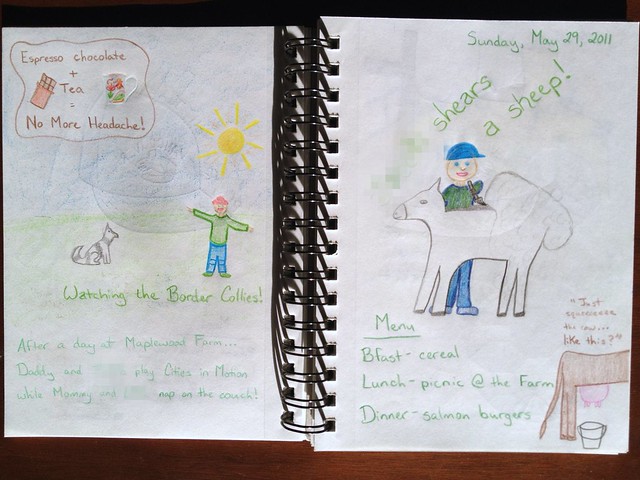
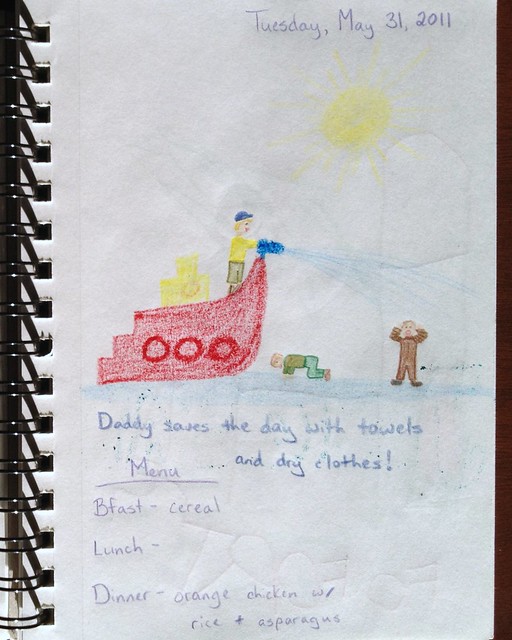
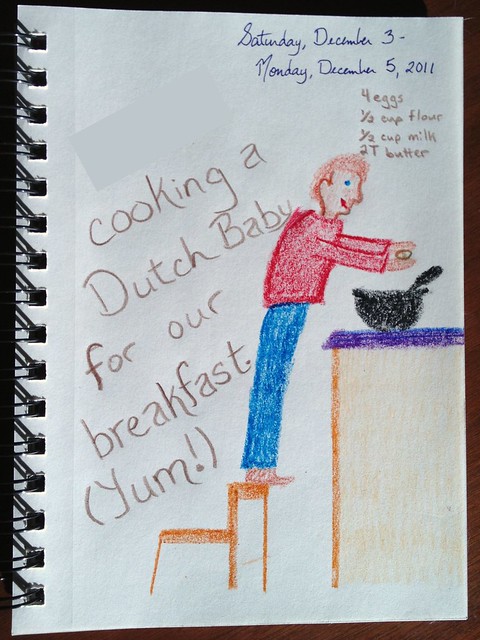
On Mother's Day this year, I sat down with a blank journal and a new pack of pencil crayons to record the day's events. It wasn't anything extravagant - the boy and I had completed a dragon puzzle together, I had done some sewing for an upcoming birthday, and I had reflected on both those who were mothers to me and those who had made me a mother - but I put it to paper anyway.

(All names removed from all photos.)

The year is ending and I look fondly through the pages. I am amazed at how strongly the recorded memories stick, no matter how little and unremarkable they seemed at the time. Some weeks I recorded daily, while busier weeks were summarized on a page; it is the detailed daily entries that best capture those ordinary moments. If I don't write it down, I will forget.

Our trip to the farm, where the boy sheared a sheep.

An unexpected soak in the local splash park.

A friend's fifth birthday party.

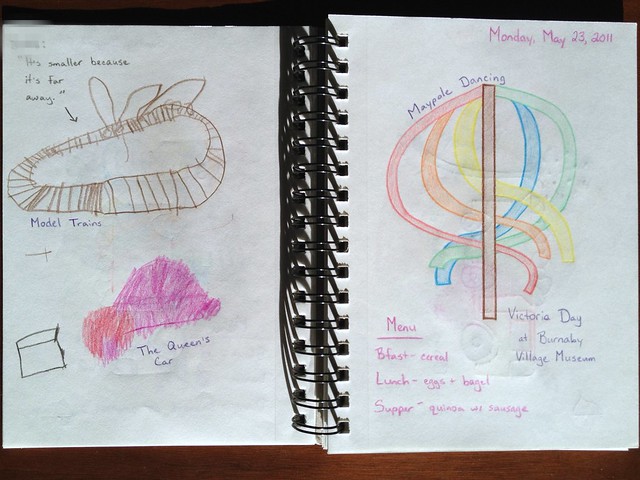
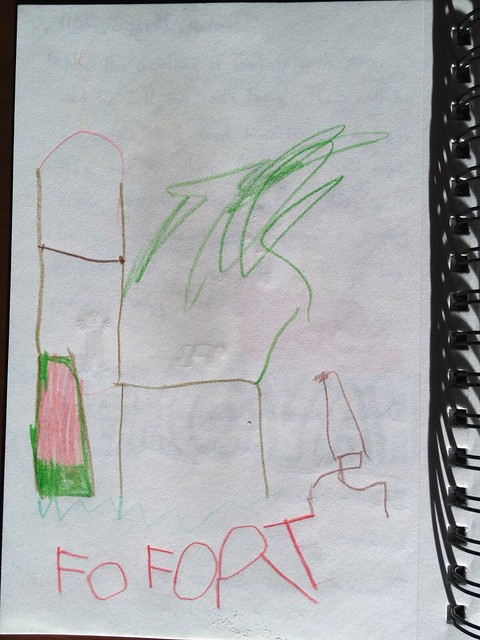
But it's not just my journal; it's our family's journal. Often the boy joins in, drawing his own memories of the day. Sometimes he labels them, asking me for help with the spelling; other times I record his descriptions and commentary.

"It's smaller because it's far away."

The day's fort.

Our trip to Playland, including riding the helicopters and the log water ride.

Sometimes even the husband can be persuaded to lend his artistic talent to our journal;
my dinosaur would have been far less impressive than his.

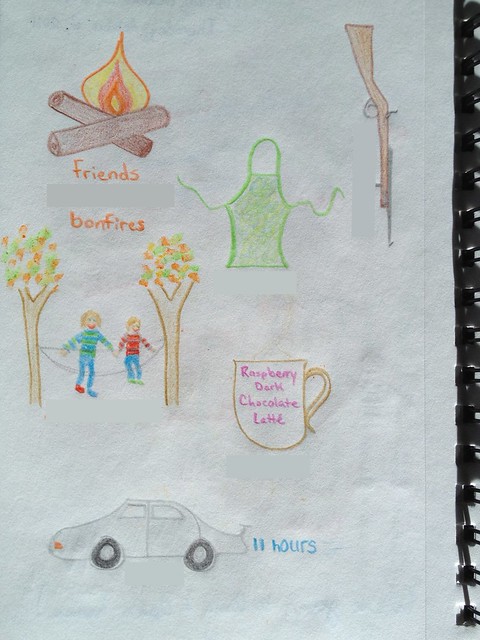
Collages of family vacations record our favourite memories of our time together. Little things, like a shared conversation over a cup of coffee raspberry dark chocolate latte, are recorded alongside the big things, like trips to the amusement park, as they are equally treasured in our hearts.

Thanksgiving with the in-laws.

A week with my mother-in-law, including some mountain climbing.

Summer vacation with the in-laws.

Summer vacation with my parents and sisters.

But as valued as those times together are, the silence upon our return can be just as golden.


Sometimes the unexpected happens, and the entries become even more precious than I initially imagined they would. Only hindsight reveals the true importance of an enjoyable yet seemingly unremarkable day.

Our last visit with Granddad, only a week before he passed away.

New favourite recipes are occasionally featured, memories of not only the ingredients and steps, but the time spent together making and then eating them.

Delicious pretzels, along with the boys' collaborative city.

Some days, Mommy just needs chocolate.

The most precious entries to me are reminders of the lessons these boys of mine have taught me. I seek to raise them in the knowledge and love of God, but it is they who teach me, opening my eyes to wonder and beauty and oh, freedom.


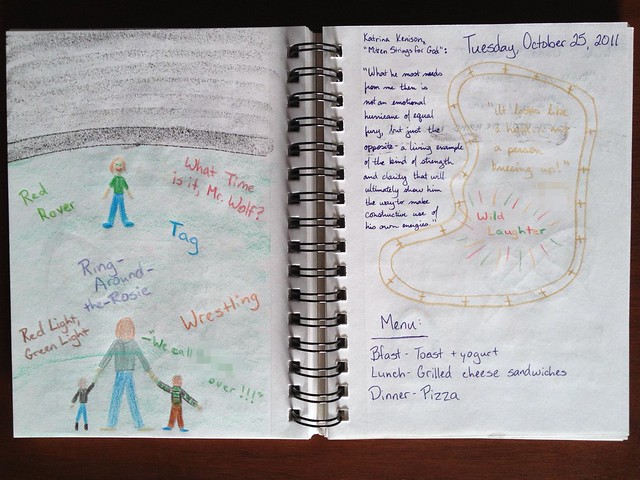
Quotes, verses, and summarized blog posts remind us of the things that had been on our hearts and minds.

"...what he most needs from me then is...strength and clarity..."

"He guides me along the right paths for his name's sake."

"...proclaim the excellencies of him who called you..."

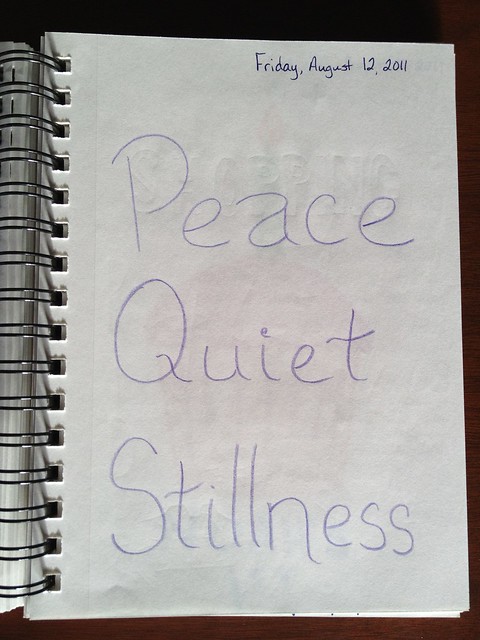
"Seek peace and pursue it."


I am no artist, but the memories remain anyway.

Truly, the boy wasn't leaning precariously off the edge of the stool,
nor does he have a hunchback, nor are our countertops bright purple.
But he sure was proud of himself for making breakfast for the family on his own that day.


Pictures and words, hopes and prayers, achievements and gratitude, menus and quotes, tragedy and comedy, daily celebrations of our life together - this family journal of ours is our place to get it all down. We collect these bits of our lives between the white pages, seeking, as always, to find the extraordinary in the most ordinary of moments.

I would love for you to share: How do you record your family's most precious memories?

Wednesday, 26 October 2011

Wordless Wednesday: Strength and clarity


(Photo courtesy of the preschooler, my budding photographer.)


"Deep down, Jack really does want to be good, but he is also strong willed and volatile, often at the mercy of his emotions. What he most needs from me then is not an emotional hurricane of equal fury, but just the opposite - a living example of the kind of strength and clarity that will ultimately show him the way to make constructive use of his own energies. Children need clear boundaries as they learn to master socially acceptable behavior, but they also need exposure to the art of self-control. Where else will my sons learn grace under pressure, if not right here in their own home?"

- Katrina Kenison, "Mitten Strings for God"

Friday, 12 August 2011

Sitting

We have said our good-byes, exchanged lingering hugs, and waved as the full vehicle pulled away from the curb. Grandparents and aunties, heading back home. It was a good week. A busy week. The boy has requested that we stay home today. Oh yes. We will stay home.

Two weeks, two sets of families. It was good to visit, and now it is good to just sit.

Our week at the beach with my in-laws was lovely and relaxing. We watched the tide come in and go back out, over and over all week long. Beautiful. The boys played in the tide pools and flew kites and dug for clams and I, I took far too many pictures and ate delicious cherries and enjoyed the daily retreat to the motel where I could sit in silence while the toddler napped.

Our week at home with my parents and sisters was full of laughter and adventure and fun. We ate picnic lunches every day while out exploring. Rollercoasters and oceans and waterslides (oh my!). We played games in the evening and stayed up too late at night and and slept in too late in the morning. It was a wonderfully full house.

Now they are gone and it is quiet here. We are all engrossed in our own activities. The sweet toddler lines books end-to-end across the couch, then oh-so-carefully stands his farm animals on them. The preschooler loses himself in Lego, humming softly to himself as he builds his creations. And I, I just sit and breathe in the quiet, the peace, as I catch up with the online world.

There are remnants. Two jars filled with wildflowers picked by the boy and my youngest sister. Belated birthday gifts on the counter. Duplo houses and a zoo. Bags of bathing suits and spare clothes near the front door and towels on the bathroom floor and spare bedding piled on the bed and oh yes, I must move the sheets to the dryer. Soon. Not yet.

Right now, I am busy sitting.

Monday, 16 May 2011

Attachment Parenting: A father's role

Today in our Attachment Parenting Series, we will be discussing the role of fathers. If you have written a post on fatherhood as it relates to Attachment Parenting, please do share it with us in the comments below!


Introduction

Fathers play a vital role in Attachment Parenting (AP).*

When the mother is the primary caregiver, she will naturally be the one to spend the greatest amount of time in contact with the baby. In the early weeks, the mother will be the one to do most of the parenting of the infant simply by virtue of the amount of time a baby spends at the breast. However, it is because of this higher contact between mother and child (when the mother is the primary caregiver) that the father should be highly involved in parenting during the time he does spend at home.

An involved father serves a two-fold purpose: he will bring his own unique offering to the child, and he will help prevent the mother from burning out.

* For simplicity’s sake, I refer to the “husband”, “father”, and “marriage”. Please expand this to fit any form of long-term partnership that involves parenting a child, where one parent stays home with the child as the primary caregiver. The unique needs of attachment parenting as a single parent require their own focus, one which I am not qualified to provide.

Unique offering

The father brings his own unique offering to his child. With the exception of physically breastfeeding the baby, the father can be involved in all areas of raising his child. This close involvement will allow a young baby to become accustomed to the father’s distinct smell, sound, and feel, providing the baby with a second strong attachment relationship. As the child grows, he or she will continue to benefit from this close relationship and from the unique offerings brought by each parent.

Preventing burnout

The father’s involvement is of particular importance when taking an AP approach to parenting because it is far too easy for a mother to become burned out when left to meet all of the child's needs alone. Although it is common for the baby to naturally prefer the mother in the early months, the father plays a central role in creating a supportive environment, helping to nurture the child by supporting the mother. A father’s involvement includes both emotional support and practical involvement.

Emotional support

When a father is supportive rather than critical, he frees the mother to share her burdens rather than bottling them up. Because AP mothers often find themselves swimming against the parenting current, they are frequently reluctant to discuss parenting struggles for fear of having the blame placed on their choice to approach parenting in an AP manner. A mother who does not face the same criticism at home will be better able to confide in her husband and seek support from him when needed.

Emotional support can take many forms, including:
  • public unity
  • verbal encouragement
  • involvement in decision-making
  • assistance with meal prep and housework
  • encouraging a tired mother to meet her own need for self-care, and
  • working with the mother to make changes when necessary.

This emotional support should begin before the baby is born with the father’s involvement in the pregnancy. In addition to the above, this involvement may include accompanying the mother to prenatal visits, talking to the baby in the womb, assisting in preparing the nursery, and encouraging the mother through labour and delivery.

Practical involvement

Although a father cannot breastfeed the child, he can support the breastfeeding relationship not only emotionally, but in practical ways as well. Does the nursing mother need a glass of water or a book? Are there meals that need to be cooked or older children that need to be interacted with?

Babywearing is an especially useful tool for fathers, encouraging a strong father-child bond as the baby becomes accustomed to the father’s unique walk, movement, heartbeat, smell, and voice. The father can wear the baby around the house, take the baby for a walk, or rock the baby to sleep.

A father can be involved in nighttime parenting as well. For the bed-sharing family, this involvement may be more supportive than practical, as sleep disruptions are minimal when the stirring baby needs only to find comfort in a nearby parent or latch on to nurse back to sleep. When the child is sleeping in his or her own space, the father can bring the baby to the mother to nurse when needed, change the baby’s diaper if necessary, and settle the baby back to sleep.

Finally, a father can be involved in the daily care of the baby and the home. This includes housekeeping, diaper changes, baths, meal prep and cleanup, bedtime routine, entertaining, comforting, and responding to the baby’s cries.

Benefits

A father’s close involvement with his child will benefit each family member individually as well as the family as a whole.

Benefits to the father

In addition to the rewards any mutually loving relationship brings, the father will benefit from the strong attachment that develops through his close involvement with his child. As connection grows, the parent/child relationship becomes increasingly natural and instinctive. The resulting mutual trust and sensitivity is the basis of the parent/child relationship and the foundation upon which future discipline will rely.

Every interaction with the baby allows the father to better read and respond to his child’s cues. The better the father knows his child and the more the child trusts the father, the easier discipline will be as the child grows. The father will also be better equipped to care for the child in the absence of the mother.

Benefits to the mother

With the assistance of an involved, nurturing father, the mother will:
  • be more rested and calm
  • be better able to meet her own needs
  • be less likely to develop postpartum depression
  • feel confident in her husband’s abilities to care for his child, and
  • benefit emotionally from the support and encouragement of her husband.

Benefits to the child

The child will benefit from having a second strong attachment relationship. Each parent offers something unique to their relationship with the child, and the child benefits from both. Having a close relationship with both parents better enables the child to grow to be a healthy, well-adjusted adult. The positive interaction with and example set by an involved father will be beneficial to the child as he or she grows.

Mothers and fathers relate to their children differently, approach discipline differently, and interact with their children differently. When the underlying approach to parenting is one of unity, these differences will balance and complement each other. The child will thrive on the unique input each parent brings into their life.

Encouraging the reluctant father

Because of the frequent contact and close proximity between mother and child, the AP mother quickly becomes adept at reading the child's cues. This can shake the confidence of a father at first. He needs to be given the opportunity to bond and learn to read his child's cues as well. AP is particularly beneficial to the father in these circumstances because it allows him to develop the deepest connection with his child in the limited time he has.

To encourage the reluctant father:
  • promote early bonding through holding and comforting
  • provide opportunities for him to learn to read his child’s cues
  • allow him to develop his own unique way of meeting the child’s needs
  • offer suggestions if needed without hovering or nitpicking (“You could try…”)
  • purchase a gender-neutral baby carrier (the Ergo is a popular “male-approved” choice)
  • provide resources for the father to develop a deeper understanding of Attachment Parenting

Summary

The father has an important role to play in Attachment Parenting, bringing his own unique offering to the child while helping to prevent the mother from burning out.

A father’s involvement includes both emotional support and practical involvement. Emotional support may include understanding, encouragement, unity, involvement in decision-making, and assistance in making changes when necessary. Practical involvement may include supporting the breastfeeding relationship, babywearing, co-sleeping, taking part in nighttime parenting, and assisting in the daily care of the baby and the home.

Attachment Parenting will allow the father to bond with his child more quickly and will give him useful tools to support the mother emotionally while assisting in the practical aspects of parenting. In addition to the benefits this offers to the mother and child, it enables the father to grow into a confident and involved parent.


Recommended Reading:

Fathers by Dr. Sears
Becoming a Father: How to Nurture and Enjoy Your Family by Dr. William Sears
Father's First Steps: 25 Things Every New Dad Should Know by Dr. Robert Sears

Tuesday, 19 April 2011

Getting outside, rain or shine

Shortly after beginning our evening walk, the rain started.

Well, maybe it'll let up right away. Let's just keep going.

It didn't let up.

But you know what? It ended up being one of the best walks we've had in a while. We listened to the various sounds of rain falling on things. We inhaled the heady scent of rain and damp soil and wet moss. We licked raindrops off our lips and shook water out of our hair. When we returned home - wet through, tired, but in good spirits - we exchanged our dripping clothes for warm pajamas and snuggled in front of the fireplace. A snack, a bedtime story, and off to bed!

The rain has kept us inside far too often - but it doesn't have to. Getting outside in the rain is the ultimate sensory activity for children, with the potential to engage all five senses.

With that in mind, here are a few favourite outdoor rainy day activities to spark your imagination (and mine!) during this rainy spring season:

Puddles: The essential rainy day activity, puddle jumping is particularly tantalizing and satisfying for children.

Mud: Get dirty? Yes, please! There's nothing quite like the feeling of mud squishing between fingers and toes.

Sticks: Find a fast-flowing ditch of water and start dropping things in. What sinks? What floats? Play Pooh sticks and see which one wins the race!

Ditches: Use shovels and sticks to channel a stream of water through ditches in the mud or sand. Add popsicle-stick bridges, mud castles, and stick flagpoles to make a whole city!

Nature walk: The classic family activity, a nature walk becomes a whole new experience in the rain.

So break out those rain boots and splash pants and get outside!

What is your favourite outdoor rainy day activity?

Monday, 11 April 2011

A morning with my second child

My preschooler had his very first playdate without me on Saturday. He looked so grown up, backpack on, holding his friend's hand as they followed her mother across the parking lot towards the Aquarium. I'll admit it, I sniffled - just a bit.

With the older boy enjoying his first playdate without me, the younger boy got to spend his first full morning with me.

He's a fun kid - I already knew that - but after spending a whole morning with just him? He's a fun kid!

We started the morning off with a slow browse through a thrift store. He was very excited when I let him walk instead of wearing him like I usually do. He chattered away as I browsed the books, occasionally taking a few sly steps down the aisle, grinning cheekily as he got further and further away from me. He pushed every button he could find in the toy aisle, calling me over to reach things that caught his attention on the higher shelves. We left half an hour later, a few dollars poorer and three books richer.

Next we stopped at a cute little coffee shop I've been wanting to check out for a while. (Laughing Bean Coffee Co, for the locals reading. I highly recommend this place - delicious food and drinks, excellent service, and a really fun atmosphere. As a bonus, they have a highchair available, something my favourite local tea shop is sadly missing.) We shared a cinnamon bun before heading to the mall, chai tea latte to go, so he could stretch his legs at the play center.

After he'd played for a while, we wandered through the mall. I picked up some streamers, balloons, and candles for the older boy's birthday on Saturday. I also picked up - gasp! - a few shirts for me! This was a rare treat indeed. There was a rather interesting moment in the change room, involving a loudly ringing cell phone, a toddler trying to escape under the door, and a distinct lack of a shirt, but the moment passed and all was well again. Plus, new shirts, so all-in-all it was definitely worth it.

After receiving the call to let me know the older boy was on his way back home, we headed back home ourselves. The little guy was so worn out from our morning that he fell asleep before we'd even gotten out of the parking lot.

Those four solid hours together gave me a renewed appreciation for the unique and fun individual he is. He has preferences and desires along with the ability to make them known - without shrieking! He listens and responds when I ask him a question. He picks up new concepts at a startling rate. He is silly one moment and sweet the next. He gives the best hugs and the sloppiest kisses. He's his own little person!

Little things, obvious things, and yet too often these are the very things that get hidden behind his older brother's bigger, louder, more exuberant personality. More often than not, if I'm going out with only one of them, it's with the older one while the younger is napping. It's the older one I've viewed as needing it more - he doesn't get the focused attention he did pre-brother, he's old enough to be excited by the prospect of special time with Mommy or Daddy, he [insert all the other reasons I've been giving myself here].

But that morning together was such a special time with my younger son; it's clear to me now that I need to make sure I get one-on-one time with each of my sweet boys. I've been so worried since his birth that he would get the raw end of the deal as the second child - all the hand-me-downs he receives, all his accomplishments that have already been achieved by his brother, fewer presents because what does he really need that his brother hasn't already been given in years past? - and yet somehow I've still allowed myself to ignore this important part of our relationship.

He's not just "the baby" anymore. He's our little boy, this unique individual forming his own unique relationship with each of us, and he needs those special times of undivided attention with us just as much as his older brother does.

I didn't think I could love anyone as much as my first son, until this little man came along and proved me wrong. He is absolutely delightful.

Two sweet and silly boys. I am a blessed mother indeed.

Friday, 4 March 2011

Nighttime transitions

After fourteen months of asking, the boy has finally gotten his wish:


He gets to sleep with his "baby bruzzer".

I've put the baby to sleep in our bed since the night he was born. But last week, after the boy asked for the four hundredth time if his little brother could ("pleeeeease") sleep in his bed with him, I decided it was as good a time as any to try.

The transition went far more smoothly than I expected. I kept our bedtime routine the same; only the location changed. After he had nursed for a while, I laid him down beside his (very excited) brother, patted his back a few times, and sat beside the bed with my laptop. A few minutes later, they were asleep.

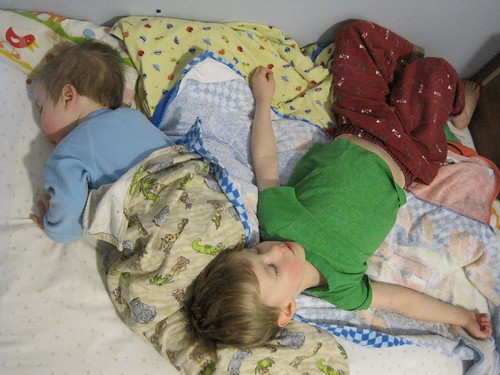
They've yet to both make it a full night there, but that's fine with me. I'm enjoying the extra space as I fall asleep at night, and I'm happy to have him back snuggling with me when he wakes up later on. The boy has his usual spot on the floor in our room, pallet and blanket ready and waiting - not that it stops him from occasionally slipping quietly into our bed instead!

I sure love these snuggly boys of mine, and I am so glad they have each other to grow up with.


(Don't forget to enter the giveaway!)

Friday, 21 January 2011

Making memories

The boys (and I include my husband here) have been making quite the forts this week. No blanket has been forgotten, no chair left neglected. As soon as a new fort is constructed, they all pile inside, giggling away. The baby especially finds the whole thing quite hysterical, which further sets off the boy, which then sets off the daddy, resulting in an endless loop of gleeful giggles.

So when dinnertime rolled around yesterday, it was no surprise to find a distinct lack of chairs at the kitchen table. Tray of baked nachos and cheese in one hand and bowl of guacamole in the other, I caught my husband's eye and we had one of those quick silent conversations that married couples so often have.

I tossed down a couple towels to protect the carpet. He transferred the nachos to a plate.

"Supper time!"

Oh, the squeals, laughter, and delighted exclamations! Supper in the fort? All of us?? Their joy is contagious; I do believe that was the most fun we've had eating supper in a long time.

These are gifts, such as they are, that I offer my children and pray they carry with them as they grow: moments that strengthen family relationships and memories of unexpected delight.

Tuesday, 11 January 2011

Home

After a total of:
25 days away from home,
30 hours travelling by car,
9 hours travelling by bus, and
6 hours travelling by plane,
we are finally back home.

Oh, how happy I am to be here again!

My introversion is squirming with joy right now. Nobody is talking to me. I'm not participating in family activities, answering questions, holding up my end of a conversation. My husband is out grocery shopping with the older boy while the younger one and our little childcare baby are napping. Nobody is requesting anything of me for these next precious moments. Bliss.

Holidays are always the hardest on this introverted soul, those rare opportunities to spend time with family, both wanting to and being expected to make the most of the visit. With so few opportunities to recharge in solitude, I always return home worn out - happy to have had the chance to spend time with loved ones, yes, but worn out nonetheless.

And then there are the simple comforts of being in one's own home. My own bed. My own food. My children's toys. Our routines. Our home.

The first half of our visit was spent with my in-laws, while the second half was spent with my parents and sisters. The two visits were as opposite as day and night, and one was certainly more challenging and less relaxing than the other. With the visits still fresh in my mind, there are a few things I want to remember for when my own grown children and grandchildren come to visit:

  • Make the house as grandchild-friendly as possible. Clear away any clutter, move the breakables out of reach, and limit the things they can get into. And for goodness' sake, don't hand a small child something with the admonishment to be very careful now, that's very special and irreplaceable! Just put it away.
  • Have on hand some things to make the visit easier. A highchair, some special "grandma's house" toys, some books, and so on. For families travelling with young children, the less they need to bring along, the better.
  • Make the spouse and grandchildren feel welcome, with their presence being an enjoyable blessing rather than an inconvenient burden. Make it clear that you consider your child's spouse to be part of your family. Expect and encourage the noise and movement of young children.
  • Approach young children the way you would a dog (pardon the analogy). When you first approach a dog, you offer your hand for it to sniff. You don't pounce on it and expect it to submit to your enthusiastic petting. Likewise with children. Give them space and let them come to you rather than demanding their immediate unbridled enthusiasm and joy at your presence. If you do choose to take the latter approach, don't be surprised or offended when they shy away from you for the rest of the visit.
  • Don't undermine the parents by deliberately attempting to introduce ideas that you know the parents have avoided. Don't act innocent and get offended when the parents call you on it.
  • Treat them like family, not guests. Having everyone pitch in with meal prep and kitchen clean up means more time to spend together, both while cleaning and after. Many hands make light work, and that work can be fun when everyone's talking and laughing together.
  • Offer to babysit so the parents can go out alone for a while. Don't insist on it.
  • Do insist that they take the gas money, and refuse to let them pay for the diapers you picked up in preparation for their arrival.
  • Relax, talk, and have fun!

What about you? What made your holiday travels and family visits easier or harder?

Friday, 24 December 2010

Merry Christmas!

"For to us a child is born, to us a son is given, and the government will be on his shoulders. And he will be called Wonderful Counselor, Mighty God, Everlasting Father, Prince of Peace. Of the greatness of his government and peace there will be no end."
Isaiah 9:6-7a

Wonderful Counselor.

Mighty God.

Everlasting Father.

Prince of Peace.

And yet...He was nothing like anyone expected. A baby born to an unwed mother and laid in the animals' feed trough. A man who preached a radical enemy-love rather than overthrowing the earthly government. A Saviour Who died on a cross, hung between two thieves.

Nothing like anyone expected.

Our Advent celebrations are over. Christmas Eve is here. The presents are wrapped and tucked under the tree. The babies are snuggled in bed in their new mama-made Christmas pajamas. Cinnamon buns are baked and ready for Christmas morning. We are surrounded by loving family: my amazing mother- and father-in-law, my two beautiful sister-in-laws, my own sister, and my sweet baby niece, all of us ready to celebrate the birth of our Saviour.

Wishing you a joyful Christmas and many blessings in the new year!


Follow the star to a place unexpected
Would you believe after all we’ve projected
A child in a manger
Lowly and small, the weakest of all
Unlikeliest hero, wrapped in his mother's shawl
Just a child, is this who we’ve waited for?


'Cause how many kings stepped down from their thrones?
How many lords have abandoned their homes?
How many greats have become the least for me?
How many gods have poured out their hearts
To romance a world that has torn all apart?
How many fathers gave up their sons for me?


Bringing our gifts for the newborn Savior
All that we have whether costly or meek
Because we believe
Gold for His honor and frankincense for His pleasure
And myrrh for the cross He’ll suffer
Do you believe, is this who we’ve waited for?
It’s who we’ve waited for?

How many kings stepped down from their thrones?
How many lords have abandoned their homes?
How many greats have become the least for me?
How many gods have poured out their hearts
To romance a world that has torn all apart?
How many fathers gave up their sons for me?
Only one did that for me

All for me
All for you
All for me
All for you

Thursday, 9 December 2010

Encouraging generosity in children

It can be hard during the Christmas season to encourage a spirit of giving, generosity, and compassion in our children. The opposite is steadily reinforced with everyone from family to strangers asking them, "what do you want for Christmas?" or "what have you asked Santa to bring you this year?" Difficult or not, there are a variety of ways we can provide our children with opportunities to cultivate generosity:

Purchase an Angel Tree gift

Angel Trees allow families to have gifts for their children under the tree on Christmas morning. Consider having each child choose a gift for a child their own age. Alternatively, purchase a gift for a teenager, as they are most often overlooked on Angel Trees. Contact your local Christmas Bureau for Angel Tree locations and for other ways you can help this season.

Donate some of their own toys

Have children go through their toys and choose some to donate to Goodwill. Not only is this an exercise in generosity, it serves the dual purpose of making room for the inevitable new toys on Christmas morning.

I found this story particularly poignant (taken from this article):
"I know of a mom and dad who had their kids go through all their toys one December and make two piles. The first pile would include the toys they planned on giving away; the second, toys they felt were worth keeping. (This made room for the new toys they’d soon receive on Christmas.)

The clincher was, this mom and dad talked about sacrificial giving, and shared how they planned to give one of their cars to a needy family. Then, they had their children give away the pile of toys they had planned to keep.

Sacrifice is true generosity. It was hard for a few moments, but unforgettable in the end. Those kids still talk about that incredible experience four years later."

Perform random acts of kindness and service

Give your children encouragement and opportunities to find ways to show others kindness. Homemade gifts for a sibling or a small act of service for a parent are great examples, and are even better when done anonymously. Brainstorm ideas with them as to what they can do to bless and serve others.

A tangible way to see the results of these small acts is to add a piece of straw to a makeshift manger with each good dead performed. In this way, they are effectively building a bed for Jesus as Christmas Day approaches.

Bake cookies for a neighbour or emergency service workers

Children can assist in baking cookies and leaving them for a neighbour. Alternatively (or in addition!), take a plate of cookies to your local firestation or police station to say thank you to those spending Christmas Eve or Christmas Day at work.

Make winter kits for homeless people

Many agencies serving homeless people hand out winter survival kits as the cold weather approaches. While you can check with your local program to find what they put in their kits, the typical one will include socks, mittens, a hat, toiletries, snacks, a blanket, and a gift card, all packed into a backpack or duffel bag. This makes an ideal group project as well.

Send cards to friends and grandparents

Give the gift of honour by sending cards to loved one. Rather than a generic Christmas message, have the child be specific in sharing why they are thankful for this person. Similarly, include children in choosing and wrapping gifts for others, allowing them to take part in the joy of giving.

Volunteer

Serving at soup kitchens and visiting nursing homes are popular ways families can volunteer to help others. Christmas Bureaus often need volunteers to sort through toy donations. Volunteering will depend on the age of the children and the opportunities available, so check with your local volunteer agency to see where your family can help this year.

Donate

Food banks often feel the crunch around the holidays, and the Salvation Army is out with their bells and red buckets. Kids enjoy dropping coins in the bucket, knowing the money will help those who need it. To make it more personal, they can do chores around the house to earn their own coins to buy a can of food or to drop in the bucket.

Share the season

Christmas can be a lonely time for many people. If you know a college student, widow, single parent, or anyone else who might be feeling alone, invite them to join in your Christmas celebrations.

Put together a box for Operation Christmas Child

Operation Christmas Child is a wonderful program that provides Christmas gifts to children in need around the world. It is a perfect opportunity for children to be involved in choosing items to prepare a gift for a child living in poverty.

New this year is Build a Box, allowing you to customize and pay for a shoebox online, to be packed and shipped by OCC volunteers. This option is less tangible for young children, but can be a good alternative if you are short on time.

Order from a gift catalogue

Samaritan's Purse, Compassion, and World Vision all have gift catalogues that allow you to provide real, practical support to those in need. With everything from soccer balls to chickens to wells, there's something for every budget. Browse through the catalogues with your children and involve them in choosing a family gift. These also make great gifts for extended family members when purchased in their name.

Don't stop after Christmas

Cultivating a spirit of generosity and compassion is a year-round venture, and the need for generosity is in no way limited to the holiday season. Find a way to make it tangible for children. One approach is to put cash in a jar, perhaps a set amount each month, a certain percent of your income, or a few dollars every time your family does something fun that costs money (add $5 to the jar every time you go out for dinner, for example). At the end of the month, sit down with your children and decide together what you will do with the money. Choose a charity to donate it to, prepare a kit for a homeless person, or use it to bless a family in need.

Most importantly, talk about how and why we give to others, and model a consistently generous, caring, and compassionate life.

How do you encourage generosity in your child(ren)?