Monday, 31 January 2011

A daily rhythm

The first month of the new year is ending. I find myself reflecting on our themes for the year - joy and rhythm - both of which have been daily on my mind this month. I learned to take joy in our quiet life, but rhythm - ah, rhythm. I have been asking myself the questions, but the answers are slow in coming. How can we best find routine in our days? How can we mark the passage of time throughout the year? What traditions can we bring into our home to bear witness to it? What are our priorities, and what can we prune to support them?

This weekend, we took our first steps toward a more intentional daily rhythm. Following the "My Day Timer" project in our Clubhouse Jr magazine (a Christmas gift from his Oma), we created a foam clock. The clock has one picture per hour; each picture corresponds to the hour's activity. We adjusted the original instructions to meet our typical day, starting with breakfast at 9:00am and ending with bedtime at 8:00pm. With lunch at 12:00pm and dinner at 6:00pm, we filled in the rest with our various activities - reading, playing, cleaning up, and so on.


9:00 Breakfast
10:00 Reading
11:00 Colouring
12:00 Lunch
1:00 Rest
2:00 Play
3:00 Outside
4:00 Snack
5:00 Play
6:00 Supper
7:00 Clean-up
8:00 Bedtime

The boy is enamored with his clock. He refers to it throughout the day, and this thing is pretty much gospel to him. When Mom says it's rest time? Whine protest whine. But when the clock says it's rest time? He's resting.

Man. I needed one of these things, like, a year ago.

So far so good, but it's only been a couple days. My concern is our (more specifically, his) flexibility on the days when our routine needs to be changed - our Thursday playgroup, weekends when Daddy is home, busy days or slow days when things just don't flow as they normally do. Still, it provides us with a starting point, and it provides my routine-loving preschooler with something tangible and interactive to refer to.

In the meantime, I'm already plotting an upgrade. Interchangeable options...velcro or magnets...weekly or monthly instead of (in addition to?) daily...we'll see.

But this? This is a good start. A movement towards rhythm. A comforting predictability.

One more step on our journey towards intentional living.

Saturday, 29 January 2011

Weekend Reading

Thursday, 27 January 2011

Unreasoning Fear

"Things happen all the time."

This is the common sentiment used to justify a constant line-of-sight supervision of our children. Don't glance away, don't leave them alone, not even for a minute, because things happen all the time.

This is a challenging discussion to have because first, it is difficult to disagree with the overarching mentality in light of horrifying personal stories, and second, any attempts to do so leave you looking both thoughtless and careless.

Stranger abduction. None of us want our children to be that "one child" it happens to. The thought is beyond horrifying. The U.S. Department of Justice reports that:

  • 797,500 children (younger than 18) were reported missing in a one-year period of time studied (1999) resulting in an average of 2,185 children being reported missing each day.
  • 203,900 children were the victims of family abductions.
  • 58,200 children were the victims of non-family abductions.
  • 115 children were the victims of “stereotypical” kidnapping. (These crimes involve someone the child does not know or someone of slight acquaintance, who holds the child overnight, transports the child 50 miles or more, kills the child, demands ransom, or intends to keep the child permanently.)
  • (source)

But when we step back and look at the risk of stranger abduction (less than one child per day in the entire United States), and then look at the very real risks to a child's development that come along with direct, constant, line-of-sight supervision at all times and in all places, the latter, I believe, has very far-reaching implications both to the individual and to society as a whole.

I am fully supportive of proactive parenting that teaches and empowers children to recognize and respond to danger. I am not comfortable with parenting that sees danger around every corner and insists on constant supervision at all times and in all places. Our fear of "stranger danger" has kept too many children indoors, in front of the television, playing video games, and surfing the web, rather than outdoors exploring, discovering, running, climbing, and building.

I also see a dangerous dichotomy in telling our children that all strangers are to be feared and yet that all adults should be automatically respected and obeyed - particularly because, statistically speaking, a child is at far greater risk from those placed in charge of them (teachers, leaders, caregivers, etc) than they are from strangers.

The very concept of "stranger danger" actually creates a more dangerous community for our children, because a) children become fearful of all strangers, including the vast majority who would help rather than harm them, and b) adults become fearful of all interactions with children, including any attempts to help them, for fear of being accused of nefarious motives (thinking, for example, of the tragic pond drowning of a two-year-old girl, because the man who saw her wandering down the street was too afraid to help her for fear of being accused of kidnapping). When all adults (particularly men) are automatically suspect, everyone loses. Community cannot bloom and thrive under these conditions.

I am in no way suggesting that we throw our children to the wolves, but I don't believe we can teach them to think for themselves, trust their own judgement, or make good decisions if they are under our constant supervision. How can they properly handle responsibility and freedom if we never give it to them nor expect it from them?

None of this is helped by media hype (sensational news sells), nor by the many organizations and individuals who stand to profit by elevating public anxiety (buy our gadget, it will help keep your child safe!). It is in many ways like our fear of germs, egged on in order to sell to the public that which was originally intended for medical professionals. Take, for example, Purrell's "imagine a touchable world" slogan, with its implication that the world is untouchable without their products, or Lysol's "Mission for Health" and "Healthy Babies" programs. But how do you make a case against these profit-driven tactics when the certain response is, "are you really willing to risk your child's life? Isn't it worth it if it might protect them?"

And yet...don't nearly all of us frequently take our children in the car? The rates of child death due to vehicular accidents is approximately twenty times greater than the rates of stranger abduction (2,863 child passengers died in 1999, to contrast the stats above, and 2,270 in 2007, to give a more recent figure (source)). But we accept that everyday risk because we believe the benefit of driving in the car is greater than the risk of our children dying in a car crash (while, of course, doing what we can to make that car trip as safe as possible, including seatbelts and extended rear-facing carseats and so on - all of which still don't bring down the death rates to anywhere near the rates of stranger abduction). Likewise, I believe the benefit of a child-appropriate "free-range childhood" is greater than the risk of stranger abduction - and I, too, will do what I can do make that free-range childhood as safe as possible by arming my children with knowledge and confidence.

Even so, nothing I could possibly do will make this life entirely safe for my children. I will pray (and pray and pray and pray) for their safety - mind, body, and soul - but I cannot eliminate all risks. To believe I can is to place undue guilt on myself while creating a false sense of security for my family.

Being aware of the real dangers is more productive than adopting a worst-case scenario mentality. Family abductions, for example, are several hundred times more common than stranger abductions. If I had an unstable ex, I would absolutely take greater precautions with my child. Likewise with child molestation - frighteningly common, especially by family members and friends.

This failure to differentiate between "things that happen all the time" and "worst-case scenarios" is highlighted, I think, in the argument that "you wouldn't leave your purse unattended, would you?" No, typically I wouldn't - because it is (relatively speaking) no big deal to snatch a purse. Snatching a child, on the other hand, takes a very rare type of person. I am reminded of the story of a man who stole a car, not realizing there was a child strapped in the back - and upon discovering the child, immediately turned the car around and returned the child to his mother. That is the very real difference I am speaking of - people will steal things, but very very few will steal a child.

At some point, my children are likely to encounter someone unsafe. I cannot remove that possibility from their lives. I can, however, give them the tools they need to avoid dangerous situations when possible, live through it if they have to, and process it in a healthy manner when it is over. As such, these are my primary goals:

  • provide skills and knowledge
  • encourage them to trust their intuition and avoid general fear
  • respect their body and teach them to do the same
  • emphasize the importance of honesty
  • remove any aura of shame from the topic
  • build a strong community in our neighbourhood

I am still working on how best to accomplish these goals, but they give me something to work towards and, ideally, prevent me from falling into a fear-based approach to parenting. I'd love to hear how you balance avoiding the irrational "stranger danger" fear/mentality while also providing your children with the tools they need to keep themselves safe.


Recommended Reading:
Free-Range Kids by Lenore Skenazy
The Gift of Fear by Gavin de Becker
Protecting the Gift by Gavin de Becker
Last Child in the Woods by Richard Louv

Wednesday, 26 January 2011

Tuesday, 25 January 2011

Christmas crafting

Here we are, one month after Christmas, and I'm finally getting caught up on pictures!

Once upon a shiny time, I had visions of entirely handmade Christmas gifts - the kids, relatives, the works. Since then, I've modified my ideal. Crafting, for me, is a joy, an expression of praise in acknowledgement of our Creator God, love and prayers woven in with each stitch. I will neither make it a chore nor craft for those who equate handmade with cheap (particularly since I rarely find homemade projects to be much, if any, cheaper than store-bought gifts).

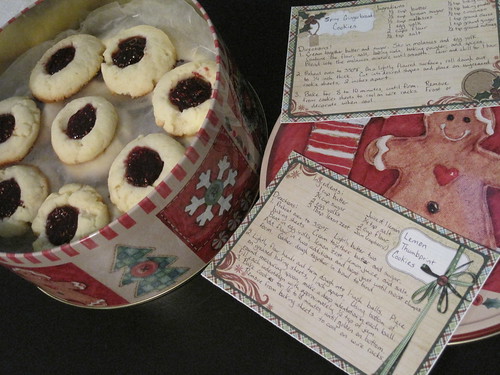
With that in mind, aside from a couple fabric bird stocking stuffers, I took on only three major Christmas crafts this year: a scrapbook album for my mom, Christmas pajamas for the boys, and a tin of cookies and recipe cards for the landlord upstairs (this barely slips in as a "craft", but you'll get a couple bonus cookie recipes out of it at the end of this post, so indulge me).


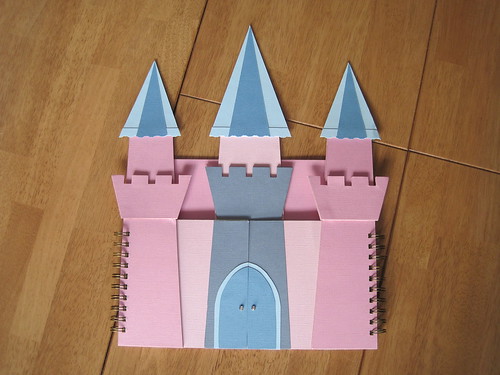
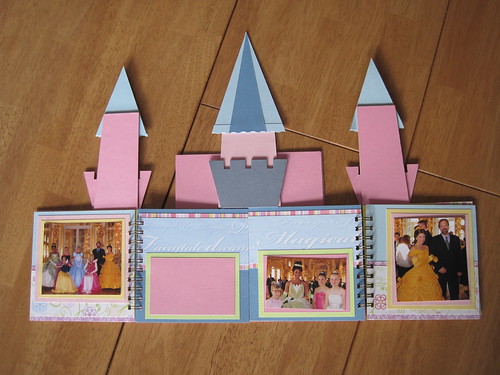
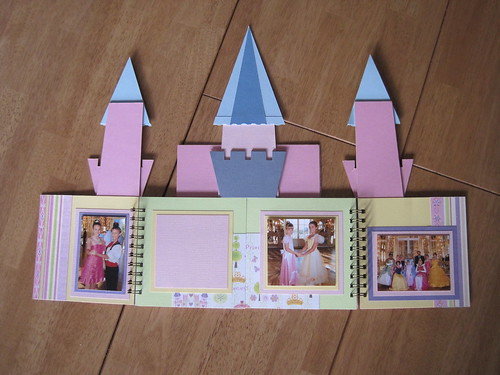
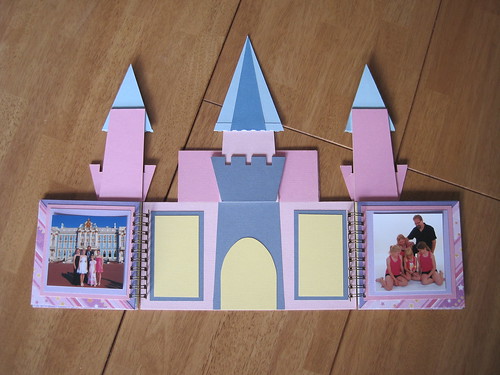
First up, the castle scrapbook. I designed and made this album for my mom. The idea was inspired by a local scrapbooking shop, which I wandered into for no particular reason one evening while having a little me-time. The album practically leapt out at me, screaming "here I am, your mom's Christmas gift!!" My mom is very Disney/princess/castle obsessed, and last year they went on a(nother) Disney Cruise that took them, among other places, to Russia where they visited a castle. It was one of the highlights of their trip. The album is half-filled with the few pictures my mom had sent me, with space for her to add in a few more.


The structure of the castle was made from chipboard covered in cardstock-weight scrapbook paper. The insides are cardstock-weight scrapbook paper stuck together and embellished with regular scrapbook paper. I used double-sided tape throughout. It was a satisfying project to work on in the evenings, and I'm reasonably happy with how it turned out.


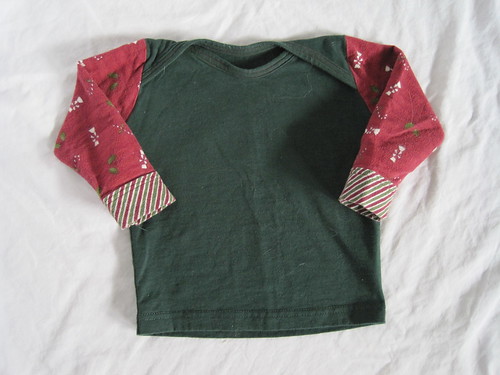
Next, the boys' Christmas pajamas. These were so much fun to make and I am very happy with the final result.

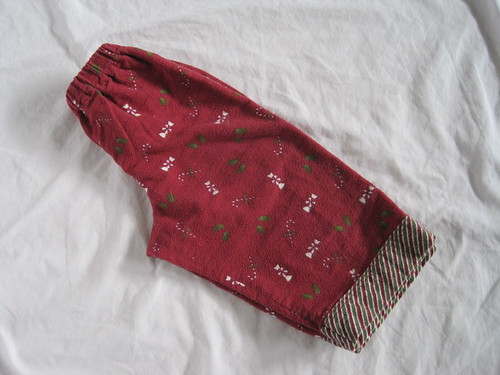
The baby's shirt was made following the 90 minute shirt tutorial. The pants were made using a basic pajama pattern I always use for them (McCall's M4643).


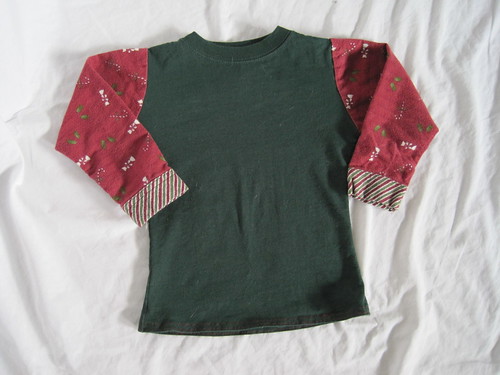
The boy's shirt was made with a more grown-up neckline, while the pants were made with the same pattern as the baby's were.


I tried to take action shots, but, well, most of them turned out pretty similar to this (that would be the boy pretending to eat the baby's head, while the baby ignored both of us in favour of the book I'd given him to try to bribe him into not crawling away):


It's hard to take pictures of two boys at the same time.


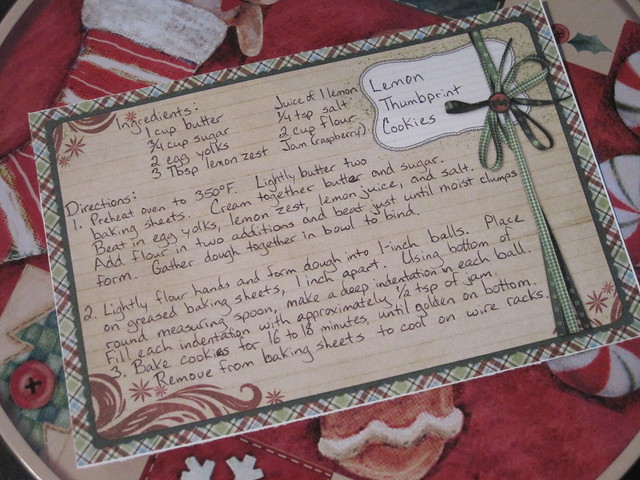
Finally, the tin of cookies with recipe cards. I made my specialty, spicy gingerbread cookies adapted from this recipe, as well as lemon thumbprint cookies with raspberry jam filling, adapted from this recipe. Wow, should I have ever made a second batch for us. Those were delicious. The recipe cards were downloaded from Shabby Princess' Holiday Recipe Collection and printed on cardstock.


And here's your bonus recipes!


Enjoy!

Sunday, 23 January 2011

The value of a life

Today is Sanctity of Human Life Sunday, a day set aside to focus on the sanctity, dignity, and intrinsic value of all human life.

This is a most worthy and important topic, and yet there too often exists a tragic incongruence even among the most staunch pro-lifers: a failure to recognize the intrinsic value of human life both before and after birth.

How can you say you're pro-life if you're also pro-death penalty? Especially considering the suggested correlation between legalized abortion and crime rates, you'll be pushing for their life at one moment, and 20 or 30 years down the road be screaming for their death.

How can you say you're pro-life while cheering on an illegal war? Those men, mothers, children, and babies don't deserve death any more than those in your own country do.

How can you say you're pro-life while failing to acknowledge children as persons worthy of respect? Where is their dignity if your desire right from birth is to dominate them and break their spirit, forcing them into a sad reflection of submission?

How can you say you're pro-life as your elderly parents sit neglected in a nursing home, with only the occasional phone call or holiday visit to look forward to? Life does not cease to be sacred as the body begins to wear out.

Don't say you're pro-life if all you really mean is anti-abortion. Today, let's truly recognize the intrinsic value of all human life - from conception until death.

"The sanctity of life doesn't end when a child is born. Life should be valued not only in the unborn child, but in babies, children, adults, and the elderly. This should give us pause to consider not only the travesty of abortion, but that of child abuse, inadequate health care, domestic abuse, elder abuse, and euthanasia. It should be reflected in the way we care for orphans and widows, for our children and our aging parents, for the homeless and victimized. It should affect our buying practices and the use of our money, time, and skills. It should be blind to borders, race, gender, age, religion, health, incomes, and lifestyle.

Our respect for the value of a life should show in the way we treat others, extending love and charity to all."

Sanctity of Human Life Sunday (from the archives)

Saturday, 22 January 2011

Weekend Reading