Monday, 15 November 2010

Meal Planning

Ah, Monday. My quiet day, my thoughtful day, my day of preparation for the week ahead.

I start the morning with a slow wander through Scripture, usually a chapter from Proverbs and a few chapters from whichever Book I am reading at the time (John, currently). I would love for this to be a daily habit, but my flesh is weak, my nature distracted, even though I know that the mornings that start off this way always lead to the calmest days. Today, though, whatever the rest of the week holds, this day at least will begin as it should.

Sometime around noon, I sit down with two pads of paper: my weekly tear-away calendar where I write down our appointments and meal plans, and my grocery list, already started and ready to round out with anything we need for the week's meals.

After reviewing our plans for the week and browsing the kitchen to see what we have on hand, I start allocating meals.

Where to begin

Busy nights call for easy meals - spaghetti, usually, using spaghetti sauce from my perpetual supply in our freezer (replenished whenever I happen to have spare ground beef and a few extra minutes), or a chicken pot pie if I have some frozen spare filling from the last time I made a batch.

Evenings where plans are uncertain are typically assigned fish, as I can defrost, prepare, bake, and have it on the table in less than hour. If it turns out we won't be eating at home that night, no harm done, the fish just stays in the freezer.

If it's only the timing of the meal that is up in the air, I often pull out my crock pot, knowing that I can have a delicious stew or chili waiting for us whenever we're ready to eat.

Wide open days are opportunities for either high-prep meals or new recipes that I want to try. Ribs, tacos with homemade shells, or a vegetarian stew over cous cous are popular picks for those days, along with a scan of my bookmarks to see what new recipes I've come across recently.

A typical day gets a typical recipe. Burgers (salmon or beef), stir fry, baked chicken, or apple pork chops along with a side dish are some typical dishes here.

Leftovers are also taken into account in the weekly meal plan. If I'm roasting a whole chicken, for example, I will turn the leftovers into chicken pot pie filling the following day. A chicken pot pie lasts us two meals, and I usually get enough filling for three pies. I make one pie and divide the remainder of the filling into freezer bags for another week.

Recipe organization

To keep from getting in a rut, I have all of my tried-and-true recipes organized in Microsoft OneNote. I keep the file open in front of me as I make my weekly meal plan. I ignored OneNote for the longest time, never imagining I would love it the way I do now. It is ridiculously easy to use, lets me keep everything in one place, and satisfies my obsessive need to organize things to the nth degree. Whenever I try a new recipe and find it good enough to make again, I add it to my OneNote recipe file.

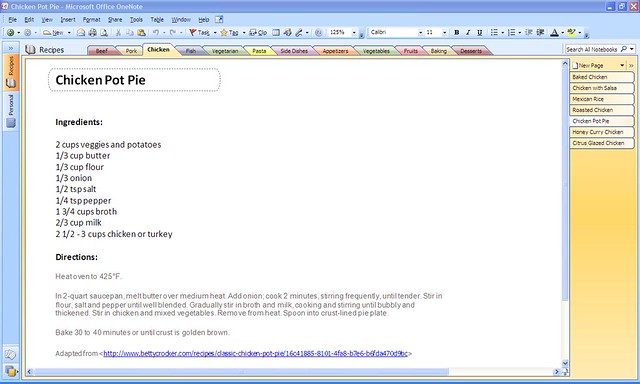
My OneNote is set up with a "Recipes" notebook and a "Personal" notebook. Each notebook is further divided into sections (Recipes: beef, pork, chicken, desserts, etc), and each section is then divided into pages (Beef: beef stew, shepherd's pie, pot roast, etc). For example, here is my Recipe notebook opened to the Chicken section (with a bonus chicken pot pie recipe if you can read the small print!):


Meal planning benefits

Meal planning has made such a big difference in our grocery spending. I am able to buy everything I needed for the week, which means less impulse buys when running out for "just one thing". There is also less waste, as I am only buying things that I will be using for a particular meal. Grocery shopping is immeasurably easier now that I'm not eyeballing the groceries in the cart and mentally putting them together into meals, hoping they'll fit into whatever the upcoming days have in store for us.

Breakfast and lunch

I only plan for dinners each week. I keep a list of balanced breakfast and lunch ideas on our fridge to keep these meals simple. When we run out of a staple, like cheese, pitas, or tortillas, I just add it to the grocery list hanging on the fridge.

Breakfast:
  • yogurt with berries

  • bagel and fruit or applesauce

  • oatmeal with berries

  • apple slices with cheese or peanut butter

  • cereal or granola

  • pancakes or waffles


Lunch:
  • bagel with avocado and cucumbers

  • pita with hummus

  • veggies with hummus

  • quesadilla with guacamole

  • soup and grilled cheese sandwiches

  • fruit salad

  • green smoothie

  • eggs


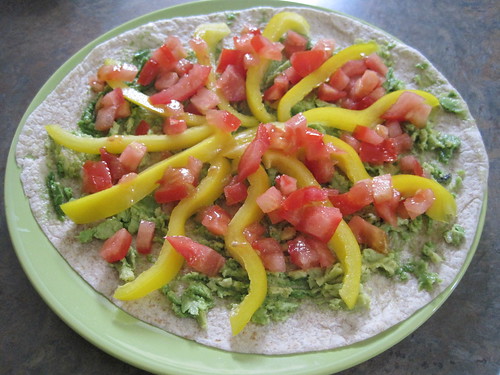
Just look at that deliciously bright quesadilla, waiting to be topped with cheese!


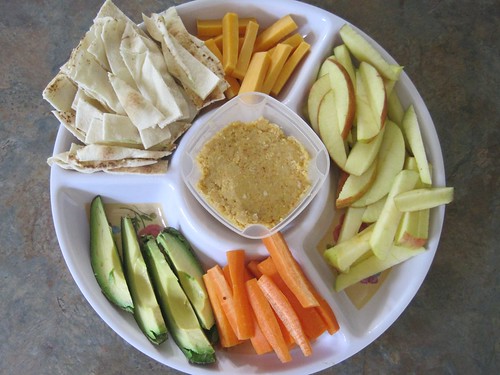
Often we'll have either a "stick lunch" or a "cube lunch" (the boy's terms), which is basically just a bunch of fruits, vegetables, cheese, and pitas sliced into sticks or cubes, with hummus for dipping.


What does a typical breakfast or lunch look like for you?

An alternative method

One method of meal planning that I don't currently use but could make things less overwhelming if you're just starting to meal plan is to assign a particular "type" of food to each day. For example, Monday is chicken, Tuesday is beef, Wednesday is fish, Thursday is vegetarian, and so on. Or Monday is Mexican, Tuesday is Asian, Wednesday is pasta, and so on. Then each week it's just a matter of assigning something from each day's category and making sure all of the ingredients are either on hand or on the grocery list.

On the menu

As I sat down to make my meal plan this week, I started with a scan of the fridge (any leftovers or wilting food to take into account?) and a review of our week. Monday is typically grocery shopping day, so I keep those meals pretty basic. My father-in-law is visiting on Wednesday, so I needed something that met his dietary requirements and would make enough for all of us. Thursday will be a busy day with a playdate plus the baby we take care of part time, so I wanted something low-prep. On Saturday we will be going on our first date in about a year (!!!), so I needed something easy for the babysitter. With those plans in mind, this is our dinner menu for the week:

  • Monday: tacos

  • Tuesday: spaghetti (using leftover ground beef from tacos)

  • Wednesday: maple salmon with rice and carrots

  • Thursday: chicken pot pie

  • Friday: leftover chicken pot pie

  • Saturday: pizza

  • Sunday: citrus glazed chicken with rice and broccoli


For more meal plans, check out Meal Plan Monday at I'm an Organizing Junkie. Happy meal planning!

Friday, 12 November 2010

The Hows of Discipline


It has been a long time since I posted my thoughts on punishment and praise. I have been meaning, for at least as long, to also post an entry on the more practical aspect - the hows.

It is a question I often receive in response to the idea of not using behaviour modification: "All of those whys are great, and I agree with them, but what about the practicalities, the specifics, the hows??" I get that. I really do. It's all well and good to delve into the myriad of reasons for avoiding punishment and praise...but then what? What can be done instead?

There is no easy answer to that. Each child, each parent, each family, each situation - they're all different. There is no formula, no prescription, no step-by-step manual, no guarantees. That is where so many of the big parenting "experts" fail - "if you just follow our method, and only our method, we guarantee you'll end up with well-behaved children."

Now, that assumes that "well-behaved" is the be all and end all of successful parenting...but I'll try to stay on track. We're dealing with the "hows" today.

I can only share tools that we have found useful in our family. They may not work for you. You may have tools that you have found particularly effective - please share them in the comments! The more tools we have, the better we can parent in a positive, proactive, and connective manner. The less we have, the more we find ourselves merely reacting to the situations our children inevitably throw our way.

First, the whole mindset for many of us needs to be completely shifted. Many, many times I hear parents looking for alternatives to punishment. "Well, if I can't punish, what can I do to deter her from doing that again?" "If the natural or logical consequence isn't unpleasant enough, how is it going to discourage that behaviour from recurring?"

We're not looking for punishment "replacements". We're not looking for consequences to teach them not to do that again. We're turning the whole thing around. We are teaching, guiding, discipling. It's hard to step out of that behaviour modification mindset. It is so ingrained in our society. Punish wrongdoing, praise good deeds, and behaviours will be appropriately modified as a result - that sort of external focus is what we want to leave behind. Instead, we want to teach our children. Not "teach them a lesson" - but actually teach them what to do.

Second, this way isn't easier. It doesn't provide any easy answers, either. It is easy to use external motivation to direct a child's external actions. We're looking deeper here. We're looking for heart-level connection, for internal motivation, for true obedience above outward compliance. It will involve patience, active parenting, and proactive measures. And it will require as its source a strong parent-child relationship based on mutual love, trust, and respect.

With those two things in mind, let's move on to the hows. These are some tools that have been working for us - not an exhaustive list by any means, but a reasonably good covering of the main ones.

Connect with your Child

None of this can be accomplished without the foundation of a strong, mutually-trusting relationship between parent and child. This relationship begins to develop from birth, as the mother responds to her child's cries and nurtures the bond between them.

Some of the things we do to strengthen that connection right from birth include gentle birth choices, nursing on demand, babywearing, and co-sleeping. As they get older, we connect through one-on-one times, special "just the two of us" outings, lots of reading, a constant flow of conversation, and physical touch (snuggles, hugs, wrestling, and games of chase). Physical touch remains important throughout the years - even a simple hand on a teen's shoulder can reinforce the parent-child connection. Talking, too, remains a priority, and listening even more so. Finally, we also work to avoid those things which would undermine our connection and relationship with our children - things like physical or punitive discipline, power struggles, and shaming. I'd love for you to share some of your methods of connection, too.

With that relationship securely in place, the child will look to the parent for cues on appropriate behaviour. The parent can model this behaviour from the beginning. Model "please", "thank you", and other such manners. Model non-violent conflict resolution. Model healthy boundaries. Model good decision making in all areas of life (time resolution, nutrition, etc), and narrate that process out loud for the child to overhear.

Be Engaged and Consistent

You can't parent from the couch (or the computer chair). Responding appropriately to a situation will often require that I get up and actively intervene. This is particularly important with young children. They need to know that my words mean something. What I say is not optional.

To make this happen, there are three things to keep in mind:
  • Stay calm. You are the adult. You are in control of your feelings and reactions. Do not give that power to your children by allowing their behaviour to influence your own feelings.
  • Speak at a normal volume. Yelling suggests to children that they don't need to pay attention to your words unless and until you yell.
  • Give the instruction once, repeat it with an offer of help, and then get up to help the child follow through if they haven't already. A long string of warnings, threats, badgerings, and pleadings tells a child that they don't need to listen to you the first time. Don't say something if you are unable or unprepared to back it up with action.
Consistency is key. Words must be consistently followed up with action.

Now, that isn't to say that I expect my children to jump the second I say so. Sometimes a child is in the middle of something and will request a few moments to finish up before putting it away. It is not permissive to respect that request when possible. This is where I find five minute warnings to be useful in helping a child prepare for an upcoming transition. If it is time to leave a fun activity, the opportunity to say good-bye provides a feeling of closure.

But the overall idea is one of consistently ensuring that my words are taken seriously. One calm instruction followed by one repeat with an offer of help followed by getting up to assist the child in carrying the instruction out. This is particularly important with very young children, as it will prevent the need for such "hands on" parenting when they are older. Once they know I mean what I say, they know.

(You can read more about this concept at Get Off Your Butt Parenting.)

Be Proactive

After consistency, prevention is the biggest thing I can do to ensure my child is able to function at his best. Adequate nutrition and sleep help to set a child up for success throughout the day. The extremes of boredom on one end and over-stimulation on the other are avoided whenever possible. Our ideal is to provide access to a wide variety of activities coupled with as much outdoor time as possible, while avoiding the trap of cramming too many structured activities, events, or errands into one day.

Along those lines, it is important to look to the root of the problem when difficulties arise. Is he hungry? Tired? Lonely? I will solve those issues first (snack, rest, focused attention), and discuss the behaviour itself at a later time when we're both feeling calm. Those calm times are ideal moments to equip our children with the tools they need to handle those feelings in more tumultuous times.

Be Silly

Playful parenting is a great way to coax a resistant child into cooperation. It often breaks the tension and allows the parent to reconnect with the child. It keeps the environment fun, light-hearted and silly. Play can be used to help a child work through their feelings. It can also be a great stress reliever and a reminder not to take things too seriously.

I recall a time, for example, when my frustrated toddler huffed at me. I could have lectured him about manners. I could have sent him to his room to rest until he was feeling more cheerful. If I believed in using violence in parenting, I could have spanked his bottom. Or...I could have huffed back at him. So I did. And he huffed back at me. And I huffed back at him. Soon we were huffing back and forth through a fit of giggles, and both of us were able to cheerfully carry on with our day.

A three week visit to Grandma and Grandpa's house resulted in another perfect example of playful parenting. As was to be expected, the boy was getting a bit grumpy by the end of the visit - a different environment, a different routine, different food, lots of people, and so on. I was sitting at the table with him one evening trying to hold on to my last shred of patience as I dealt with him heading towards a meltdown. Noticing this, his grandpa stepped in to help.

"Do I have to bring out my grumpy monster? This is my grumpy monster (holds up his hand) and he eats grumpies! Yum yum yum yum yum!"

The boy dissolved into a fit of giggles as his grandpa used his "grumpy monster" to eat/tickle him. It was a wonderful example of my dad using playful (grand)parenting to circumvent what would almost surely have been a complete meltdown in another minute or two.

Avoid Power Struggles

There are situations that warrant explanation and situations where brevity is in everyone's best interest. As always, it is important to know your child. Typically, I will give my child a brief reason for my requests. This allows a child to develop an understanding of why he should make that decision, rather than an unhelpful "because I said so". My goal is to teach my child how to think, not merely what to think.

However, there are many times when engaging with a child will unnecessarily escalate the situation, times when he is simply tired, grumpy, and not at all in a place to accept any explanation. At those times, my responses will be very brief and matter-of-fact. There's no need to dwell on the situation or attempt to convince the child through long explanations. I will not engage in a back and forth yes!-no!-yes!-no! power struggle with a child, nor will I enforce my instructions with yelling or hitting. Doing so will only undermine my authority as a parent. Remaining calm and to-the-point, I will simply answer and move on. "No, you may not keep your light on. Here is your nightlight. Which CD do you want to listen to?"

Redirection comes into play here as well, particularly with older babies and toddlers. "You may not play with that. Here is this for you to play with." I do not dwell or engage, I simply state my instruction and move on, redirecting the child to an appropriate activity.

When the situation warrants it, I will reflect my child's feelings back to him and, if needed, offer help in expressing those feelings in a healthy, appropriate, and acceptable manner.

Seek Solutions

Sometimes wrongdoings will be done. When that happens, we look for solutions, not punishments. Children grow in maturity and responsibility when they are given the opportunity to fix their mistakes. Punishment actually takes this opportunity away from them.

How this plays out in our home varies depending on the situation. It typically involves making restitution to the wronged party. I will assist him in brainstorming what this restitution may look like, but the bulk of the responsibility (and, of course, increasingly so as he gets older) rests on his shoulders. "You hurt the baby. What can you do to help him feel better?"

There must also be an acceptance of the fact that children are by their very nature not yet mature. They will require repetition in order to form healthy habits. "Try again" is a very common phrase in our home, as a reminder that what they just said was unacceptable and an opportunity for them to restate things in a more appropriate manner.

Safety

Because dangerous situations are often singled out as the situation in which punitive measures are justified or warranted, I wanted to touch on this area separately.

I do not want to spank my child for running into traffic, only to later have him run in the opposite direction from my call, fearing another spank. It is my responsibility to keep my child safe, not his.

I have found that a sharp surprised tone conveys enough "this is absolutely serious" that my child will at least hesitate, allowing me to intervene. I reserve that tone only for situations in which safety is a concern - ovens, fire, traffic, and the like. I do not believe that violence towards children is ever warranted or acceptable.

Final Thoughts

Discipline is the continuous process of coming alongside the child to teach and guide them into maturity. The idea always is to teach, not punish. This cannot happen in the absence of a healthy, attached relationship between parent and child. With that relationship in place and moments of reconnection continually sought out, we must then be engaged, consistent, and proactive in our parenting. When an issue arises, discipline will show the child what they have done wrong, give them ownership of the problem, give them options for solving the problem, and make use of natural or logical consequences rather than punishment.

Some days we may allow life to get the better of us, snapping at our children or scolding them unnecessarily. This is where it is important that they see humility modeled for them as we come to them and admit we were wrong, sincerely apologize, and ask their forgiveness.

Above all, we must recognise and honour the unique nature of each child, guiding them towards maturity with love and grace.

Additional Resources:
Gentle Discipline for Babies
Gentle Discipline for Toddlers
Attachment Parenting Series

What has been working for you? What situations are you struggling with at the moment? Let's brainstorm positive solutions together!

Wednesday, 10 November 2010

Tuesday, 9 November 2010

The days are long

The baby beside me cries, protesting another nap.

Head throbs. Eyes fill. Patience falters.

Why are they so needy? I feel like I have nothing left to give today. It's never enough. I've read endless stories. I've built playdough cars. I've cooked and fed and cleaned. I've changed diapers, wiped bottoms. I've nursed and nursed and nursed.

Soon their father will be home, hungry, wanting supper before heading to work for the evening, leaving me alone again to care and clean and put them to bed. Then more cleaning, and then surely one of them will wake, needing my comfort, and perhaps when they are once again asleep I will finally finally finally have a moment to sit down and just be still.

Be still.

The baby stops crying, considers sleep. The door opens and I cringe, try to silently shoo the lonely boy out, mouthing I'll be right there.

But no, "I have something for you, Mommy." He holds it towards me and how can I refuse? I nod him in. He rushes over and hands me the gift, a blue pipecleaner he's made into a flower for me, his mama, the one who has today snapped at him more times than she wants to admit. No! Hurry! Faster! Stop! My precious boy, I'm so sorry.

I smile my thanks and assure him again that I will be there soon, there to meet more needs, to give more of myself.

The phone rings and I know he'll bring it to me, he always does, and sure enough the ringing soon fills the room and the baby cries again and I've missed the call anyway and my head pounds harder.

I think of all the times I've dreamed of going to another country to cuddle and care for lonely babies, babies who have no mother and father. But the cries nudge me, you have babies here, and they too need my love and touch and care. I am doing the Father's work. I am caring for these children, these ones here in my home, these ones I have been given, these two boys of mine and the sweet third who joins us during our long days.

I recall what older, wiser mothers have told me: The days are long, but the years are short. I know I will see the truth in it one day, looking back. Some days are just like this. Tonight we'll snuggle, pick out the best moments of the day and offer them up to God as thanks.

And tomorrow we'll try again.

Monday, 8 November 2010

Capitalizing on breastfeeding moms

Similac has a new kid on the block here in Canada: Similac Mom, a nutritional beverage for pregnant and breastfeeding mothers.

What a brilliant marketing scheme.

Brand Loyalty

Hook 'em early. Prey on a pregnant mother's fears, convince her that she needs your product to ensure both she and the growing child in her womb are receiving all the nutrition they need. And when that child is born? Well, do they have the formula for you! You cannot be trusted. Your body cannot be trusted. You need their products.

I found this quote for the Singapore equivalent to be rather telling:
"During my second pregnancy, I started drinking Similac Mum, the new maternal supplement by the maker of Similac Follow-On. It gave me the nutrients required for my baby's overall development during pregnancy and breastfeeding. What's more, it is low in fat, helping me to get back in shape faster.

When the time is right, I will surely give my new baby Similac Follow-On. So that he can be strong and healthy, like his big brother. Clearly, there is a special bond between me, my babies and Similac."

Expanded Target Market

If you can't beat 'em, join 'em. If you can't get the babies, go after the moms instead. They'll get your money one way or another. Can't convince a mother that she needs infant formula? Fine. After all, "breast is best", blah blah blah. But you must make sure that you are getting all the nutrition you need while you're breastfeeding, for your sake and the sake of your breastfed child. Enter Similac Mom, for all your complete-nutrition-while-breastfeeding needs! (Oh yes, and when you're done with that cute little breastfeeding stuff, we're right here with your baby and toddler formulas.)

But What's in It?

Their ingredient list isn't quite so reassuring:
Water, sugar (sucrose), sodium and calcium caseinate, corn maltodextrin, high oleic safflower oil, canola oil, soy protein isolate, corn oil, potassium citrate, sodium citrate, calcium phosphate, magnesium phosphate, natural and artificial flavour, magnesium chloride, salt (sodium chloride), soy lecithin, potassium phosphate, carrageenan, ascorbic acid, zinc sulphate, ferrous sulphate, niacinamide, dl-α-tocopheryl acetate, manganese sulphate, cupric sulphate, calcium pantothenate, vitamin A palmitate, pyridoxine hydrochloride, thiamine chloride hydrochloride, riboflavin, folic acid, potassium iodide, sodium molybdate, biotin, sodium selenate, chromium chloride, vitamin D3, cyanocobalamin.

With sugar second only to water, and all fats received in the form of oils (safflower, canola, and corn), any pregnant or nursing mother would do far better with a simple multivitamin in addition to daily meals. The one thing this supplement is lacking? Food.

This new product is being pushed towards women for whom a balanced diet may not be easy - pregnant women battling morning sickness and new mothers who are tired, busy and looking for convenience. In regards to the former, a prenatal vitamin in addition to whatever food you can manage to keep down will be more than enough to care for you and your unborn child. If you can't keep anything down, why would Similac's product be any different? As for the latter, a reasonably balanced diet can be achieved from real foods without a lot of time or effort, despite what Similac would like you to think. Nuts, cheese, apples, bananas, trail mix, and more can all be grabbed quickly and effortlessly to give you the nutrition you need during those early sleep-deprived and busy days.

Questionable Tactics

This is not Similac's first use of questionable tactics when it comes to dealing with breastfeeding mothers. Then again, perhaps Similac can't be faulted for looking out for their bottom line through the development of brand loyalty and expanded target markets. It is, after all, basic marketing. The savvy consumer, however, should be aware of these goals and make their purchasing decisions with them in mind. Similac is playing on our fears (adequate nutrition) and our weaknesses (convenience). Pretending that they have our best interests at heart is simply insulting.

Conscious Choices

Many mothers choose to breastfeed their infants out of a sincere desire to give their children the best they can. If formula is not an adequate substitute for your baby, why is an adult formula an acceptable alternative for you?

Other mothers are unable to breastfeed, and for them formula is a lifesaving alternative for their children. Others choose to use formula for their child for any number of reasons. I am not judging a mother's choice. Not being in her shoes, not knowing what journey she is on or what led her to where she is now, I will support her decision to feed her child in the manner she believes to be best for the two of them.

What I will not support is a corporation's attempts to convince pregnant and breastfeeding mothers that "complete nutrition" comes packaged in a convenient bottle. It undermines trust in one's body and the consumption of real food before the baby is even born. It makes the leap to formula use that one step easier, one step more normative - which is precisely what they're hoping for.

Regardless of our choices, we must remain conscious of our purchasing power. Eat real foods. Get to know your local farmer and support him or her rather than giving your money to a faceless formula company. And if you choose to purchase Similac Mom, do so because it truly was your choice and not because they told you you needed to.

Sunday, 7 November 2010

Mister Independent

I walked into the kitchen yesterday morning to find that the boy was already contentedly eating his breakfast.

He had got the cereal down from the top of the fridge, poured it into a bowl, poured milk on it, put the milk away, and sat down with a spoon to eat. I was impressed!

(We'll ignore the fact that the bowl and spoon were dirty dishes that had been on the table from the previous night's bedtime snack of applesauce. He is, after all, only three.)

This boy is growing up too fast.